Fraser-Kirk Plastic Surgery
Sunshine Coast
Level 3/37 The Esplanade,
Maroochydore QLD 4558
A different philosophy for treating facial ageing. When patients come to me asking about a face and neck lift, I often find myself having a slightly different conversation than they expect. In many cases a facelift is exactly the right answer. The difference is that what most people picture when they think of a facelift, […]
When patients come to me asking about a face and neck lift, I often find myself having a slightly different conversation than they expect. In many cases a facelift is exactly the right answer. The difference is that what most people picture when they think of a facelift, and what I actually do in the operating theatre, are meaningfully different things.
I want to explain my approach, why it differs from conventional technique, and why I believe that difference matters for the result.
A traditional face and neck lift addresses one of the most visible consequences of ageing — descent of the facial soft tissues and loosening of the skin. It lifts and re-drapes. Done well, it produces real improvement. There are, however, important dimensions of facial ageing that lifting alone does not address.
First, it treats the face as though ageing is a single-dimensional problem — the pull of gravity over time. In reality, facial ageing is multidimensional. The skin changes in quality as well as in position. Volume is lost from the deep fat compartments — most notably in the mid face — creating shadows and hollowing that lifting alone does not correct. In certain patients, the brow descends and the upper eyelid becomes heavy. The neck changes through loose skin and also through changes in the underlying anatomy of the platysma muscle and the deeper structures that define the jawline, such as the submandibular and parotid salivary glands.
Second, conventional technique — even when expertly performed — tends to address only the superficial musculoaponeurotic system (the SMAS layer) of the face and neck.
This is the reasoning behind the approach I take.
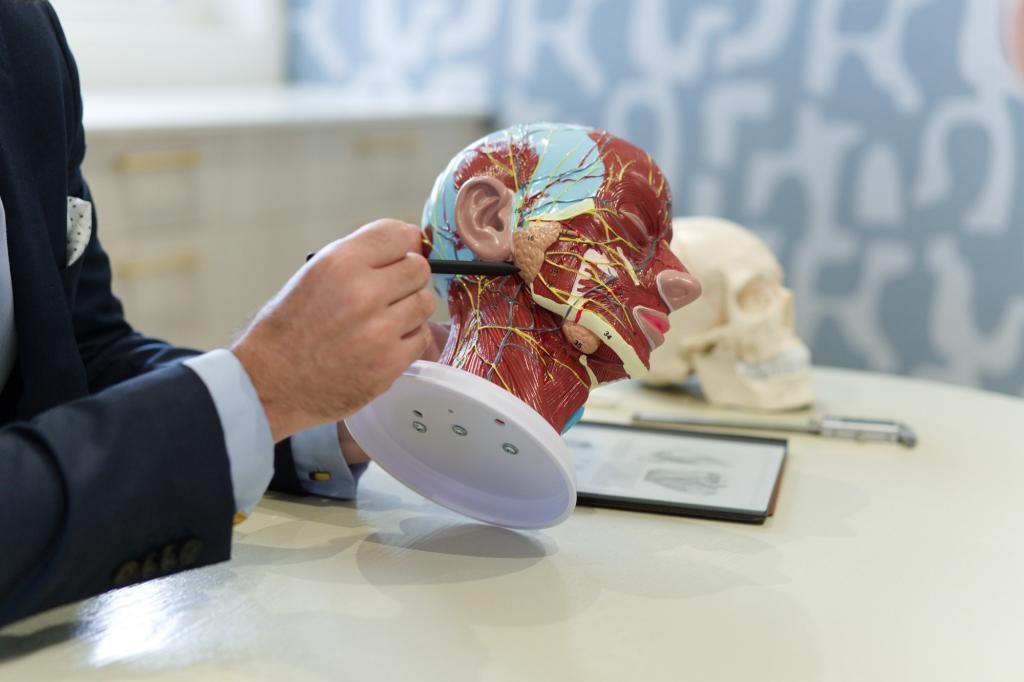
My approach is built around treating facial ageing comprehensively — addressing all of the anatomical layers and regions that change with ageing in a single, coordinated surgical episode. It is a more technically demanding and longer procedure, undertaken so that the different elements of facial ageing can be addressed together rather than in isolation.
The foundation is an extended deep plane face and neck lift — a technique that releases and repositions the face at a deeper anatomical plane than conventional SMAS lifting. Rather than tightening tissue superficially, we work at the level of the retaining ligaments and deep facial layers, allowing the entire facial soft tissue unit to be moved as a composite. My approach to this technique draws on methods I learned from Rick Warren in Vancouver, George Orfaniotis in London, and Ben Talei in Beverly Hills — surgeons who have each contributed to the development of deep plane technique.
The neck requires its own dedicated anatomical strategy. My approach involves midline platysma plication — tightening the platysmal bands that create the characteristic “turkey neck” appearance — combined with a mastoid crevasse plication technique to set the posterior neck angle and define the contour where the neck meets the skull behind the ear.
Where the anatomy requires it, I also perform selective deep neck reduction: precise contouring of the submandibular glands, parotid tail, and anterior digastric muscle. These structures contribute to a full or heavy jawline and lower face in a way that lifting alone cannot resolve. Addressing these structures contributes to jawline definition that repositioning of the soft tissues alone does not provide.
Lifting repositions tissue. It does not restore what has been lost. Volume loss — particularly in the mid face — is a prominent sign of facial ageing, and one that is frequently under-addressed or addressed with fillers in a way that can over-volumise the face over time.
I use bespoke small-volume autologous fat grafting — meaning fat taken from the patient’s own body and precisely placed in the deep fat compartments of the mid face — to restore facial volume in the right anatomical locations. I also use micro-fat grafting to other selected areas as required, such as the sub-brow region amongst others. The fat is placed structurally, to restore volume within these compartments. The volumes used are deliberate and conservative.
For skin quality in the perioral region and anterior neck — areas where skin ageing is particularly pronounced — I use nano-fat grafting. Nano-fat is a filtered, emulsified preparation of the patient’s own fat containing stromal vascular fraction. Placed intradermally, it is used to support skin quality rather than to add volume.
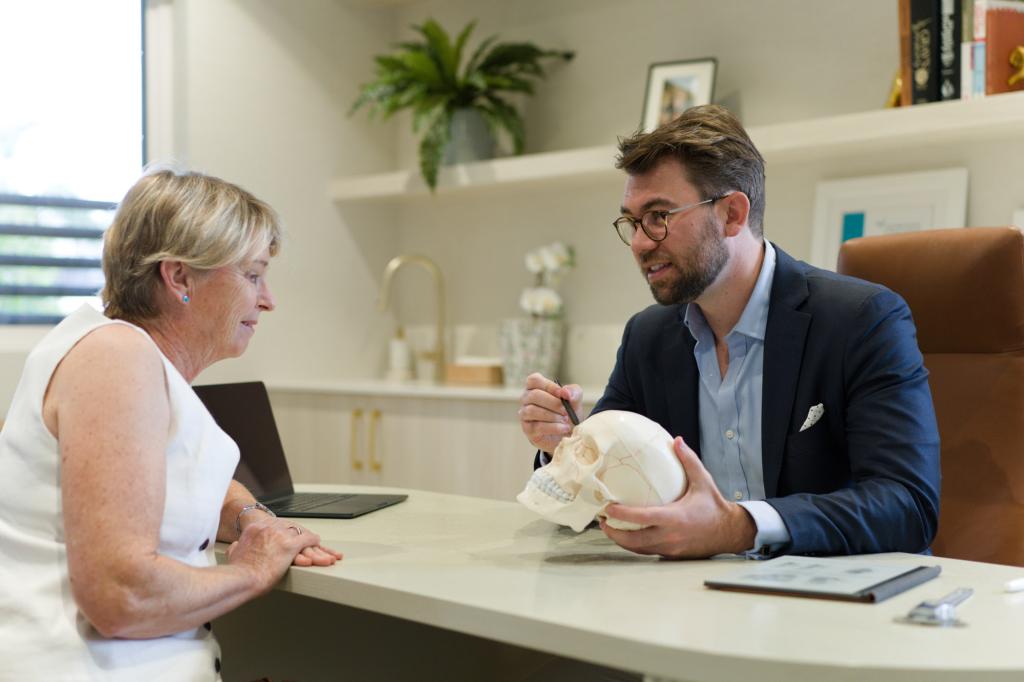
Facial ageing does not stop at the cheeks. Brow descent is one of the earliest changes in the upper face, contributing to upper eyelid heaviness, a tired appearance, and loss of the arched brow contour that frames the eye. Where indicated, I perform endoscopic-assisted brow elevation as part of the same surgical episode. Beyond lifting the brow, this technique allows precise management of the skin envelope in the temple area — an important consideration in preventing distortion of the hairline and sideburn that can be a telltale sign of facelift surgery.
My aim in facial surgery is to address the full range of changes that occur with ageing, rather than the most visible ones alone. That means working at the appropriate anatomical depth, considering volume where it has been lost, and treating the neck and brow as part of the same surgical plan rather than as separate concerns to be deferred or ignored.
This is what I mean by a complete approach to facial ageing. It is a more demanding surgical undertaking — for surgeon and patient alike — and for the right candidate, I believe it offers a thorough and considered approach. Whether it is appropriate for you is something we would discuss carefully at consultation.
A face and neck lift is a major surgical procedure performed under anaesthesia, and as with any surgery it carries risks. These can include bleeding, haematoma, infection, delayed wound healing, scarring, asymmetry, changes in skin sensation, hair loss around the incisions, and temporary or, less commonly, longer-lasting injury to the nerves that control facial movement. There are also risks associated with general anaesthesia. Outcomes vary between individuals, and not everyone is a suitable candidate.
Before proceeding with cosmetic surgery, a referral from your GP or another registered medical practitioner is required, and a seven-day cooling-off period applies for adults. The risks relevant to your individual circumstances will be discussed with you in full during your consultation.
I consult at The Coastal Clinic on the Gold Coast and Fraser-Kirk Plastic Surgery on the Sunshine Coast. If you would like to understand whether this approach is appropriate for you, I welcome an initial consultation.







All surgery and invasive procedures carry risks. Before proceeding, you should seek a second opinion from an appropriately qualified health practitioner. Read our full information on the risks of surgery. Dr David Sparks — Specialist Plastic Surgeon, MED0001863770.