Fraser-Kirk Plastic Surgery
Sunshine Coast
Level 3/37 The Esplanade,
Maroochydore QLD 4558
Patient profile
Age: Early 60s | Sex: Female | Previous surgery: Left cheek cyst excision
Photography: Preoperative & 6 weeks postoperative
This case describes the surgical management of facial and cervical ageing in a woman in her early 60s, who presented with change across the upper, mid and lower face and the neck. Alongside her age-related changes, residual soft tissue deficiency and a surgical scar of the left cheek — following prior excision of a large cyst — introduced an element of facial asymmetry that required specific attention within the operative plan.
The findings spanned the upper, mid and lower face and neck: brow ptosis with flattening of the lateral brow, midface descent with loss of cheek projection, deepened nasolabial folds, jowling with loss of jawline definition, and an undefined neck with an obtuse cervicomental angle. Left cheek soft tissue deficiency from the prior cyst excision added an asymmetric component requiring targeted volume correction. Her goals were to address these changes across the face and neck and to address the left cheek asymmetry.
The surgical plan was designed to address the full anatomical distribution of facial and cervical ageing in a layered, technically precise fashion. Each component of the plan was selected for this patient’s specific anatomy, priorities, and clinical findings.
The deep plane facelift was chosen as the primary approach given the degree of midface descent and lower facial soft tissue ptosis. Extension of the deep plane dissection into the midface allowed simultaneous repositioning of descended midfacial structures — including the malar fat pad and associated soft tissues — without the need for a separate midface lift incision, providing a unified vector of correction from cheek to neck.
The endoscopic brow lift was planned to address lateral brow flattening and ptosis through a minimally invasive approach with small scalp incisions, avoiding a coronal scar whilst restoring the brow arch and upper facial balance.
Fat grafting was incorporated to address both generalised midface volume loss and the specific asymmetry of the left cheek. The inherent variability of fat graft take was discussed with the patient preoperatively, and realistic expectations were established regarding the degree of volume correction achievable in the setting of prior soft tissue disruption from cyst excision.
A combined anterior and lateral approach to the neck was planned to address both platysmal banding and lateral cervical laxity. The absence of clinically significant submandibular gland excess meant that submandibular gland reduction was not indicated, thereby avoiding the associated risks of that procedure without detriment to the anticipated neck result. Digastric muscle reduction was planned given the palpable and visible prominence in the submental region.
A deep plane facelift was performed bilaterally, incorporating release of the retaining ligaments of the face — including the zygomatic and masseteric cutaneous ligaments — to allow mobilisation and repositioning of the SMAS-platysma-facial soft tissue composite. The soft tissue is repositioned as a composite unit with its intrinsic blood supply preserved, rather than relying on skin tension alone.
The deep plane dissection was extended superiorly and medially into the midface to engage and reposition the descended malar fat pad and midfacial soft tissues. This extended dissection addressed midface volume loss and deepened nasolabial folds by repositioning the soft tissue envelope to its anatomical position, rather than relying on volume augmentation alone.
An endoscopic brow lift was performed using small scalp port incisions to allow subperiosteal release and repositioning of the brow-forehead unit. The technique permitted controlled correction of lateral brow ptosis and restoration of the brow arch without a coronal incision, minimising scalp scar burden and reducing the risk of sensory disturbance. Fixation was performed to maintain the new brow position over time.
A neck lift was performed using a combined anterior and lateral approach to address all components of cervical ageing identified at preoperative assessment.
Anteriorly, the platysma was accessed through a submental incision to allow direct visualisation and midline plication of the dehisced platysmal bands. Re-approximation of the platysma in the midline restored muscular continuity, addressed the anterior neck banding.
Laterally, the platysma was addressed through the facelift approach, allowing lateral plication and repositioning of the lateral neck soft tissues in continuity with the deep plane facelift. Mastoid crevasse fixation was performed to provide durable anchoring of the repositioned lateral neck and lower facial soft tissues to the mastoid periosteum, establishing a lateral vector and contributing to maintained jawline and neck definition over time.
The anterior bellies of the digastric muscles were identified in the submental compartment and selectively reduced by controlled shaving to diminish their prominence in the submental region. This step addressed the residual submental convexity that would not have been addressed by skin re-draping or platysma management alone, and contributed to a smoother submental contour.
Intraoperative assessment confirmed the absence of significant submandibular gland excess. Accordingly, partial submandibular gland resection was not performed. Avoiding this step eliminated the associated risks — including marginal mandibular nerve injury and salivary complications — without compromise to the cervical contour result, which was achieved through muscular recontouring, suspension, and skin re-draping.
Structural fat grafting was performed to multiple facial regions to address both generalised volume loss and left cheek asymmetry. Fat was harvested from an appropriate donor site, processed by micronisation, and grafted to the bilateral malar regions and specifically to the left cheek soft tissue deficiency at the site of prior cyst excision.
Fat grafting to the left cheek aimed to partially correct the volume asymmetry by supplementing the deficient soft tissue envelope. It is important to note that fat grafting outcomes are inherently variable — graft retention is influenced by local tissue vascularity, recipient site characteristics, and biological factors that cannot be fully controlled at the time of surgery. In areas of prior soft tissue disruption, such as this patient’s left cheek, the local tissue environment may reduce the predictability of graft take. This variability was discussed with the patient preoperatively, and the result in this region represents a partial correction of asymmetry consistent with what can reasonably be expected.
At six weeks postoperatively, change was visible across the targeted areas of the face and neck. It is important to note that the full maturation of surgical results — including resolution of residual swelling, scar softening, and tissue settling — continues well beyond this early timepoint, and results will continue to settle over subsequent months.
The anterior cervical and submental scars are maturing and are expected to fade further with time. The patient’s recovery was uncomplicated, with expected postoperative swelling resolving progressively.
Recovery from combined face and neck lift surgery, with the additional brow lift and fat grafting in this case, follows a general pattern, though it varies between individuals:
A GP referral is recommended before a surgical consultation, and a cooling-off period applies before proceeding with cosmetic surgery. All surgery carries risk; full information on the risks of surgery and recovery is available here, and a second opinion from an appropriately qualified health practitioner is encouraged.
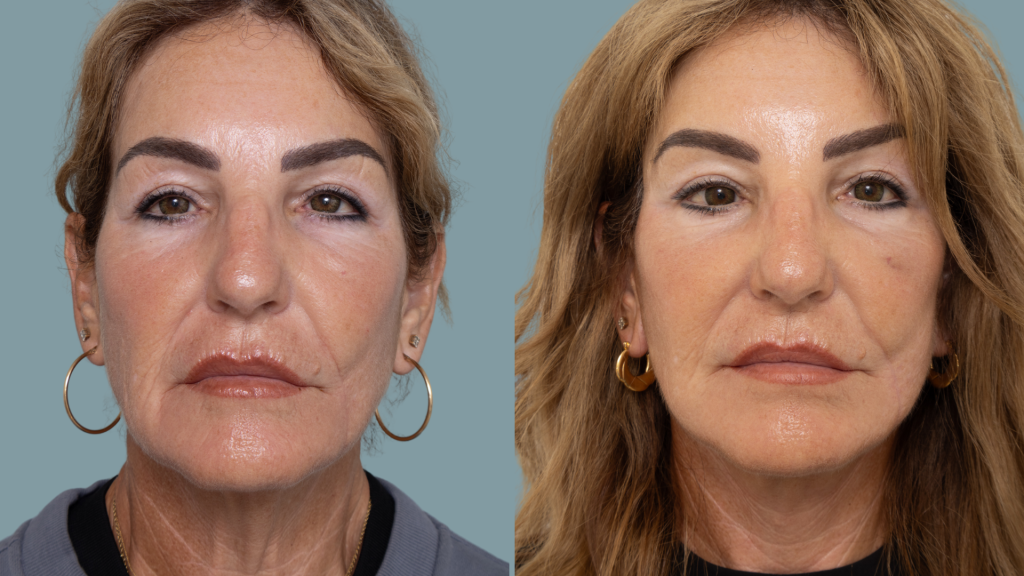
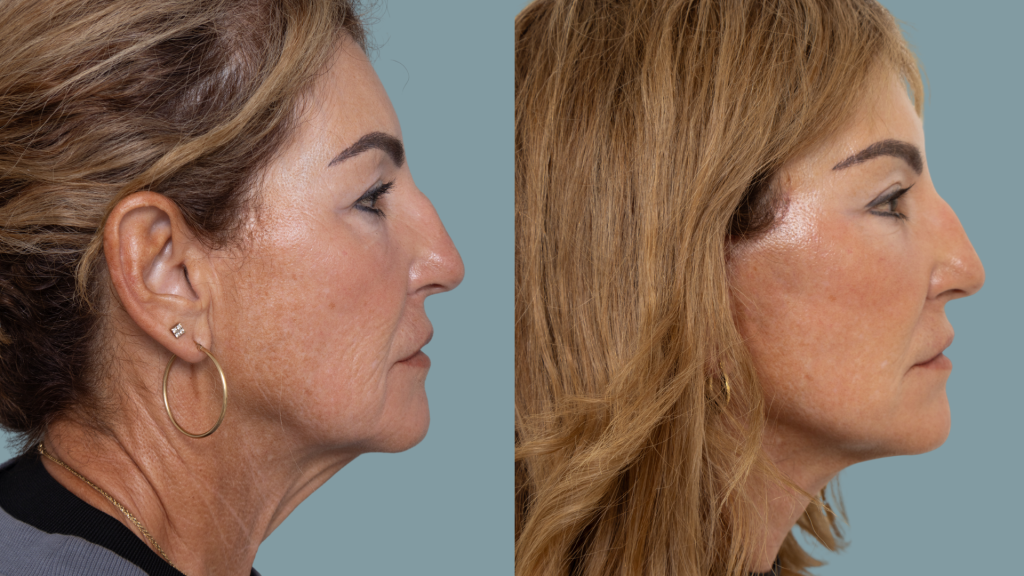
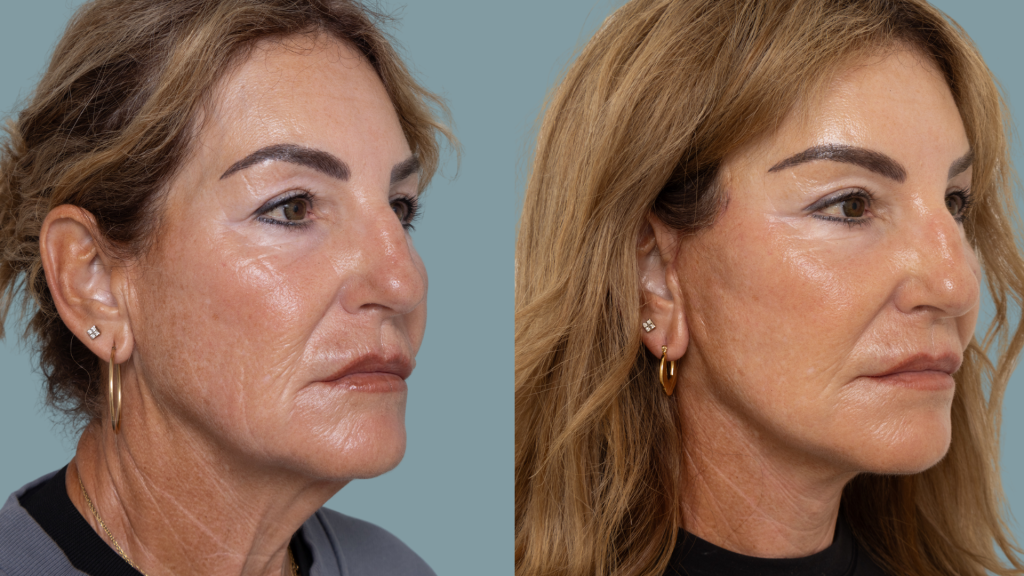
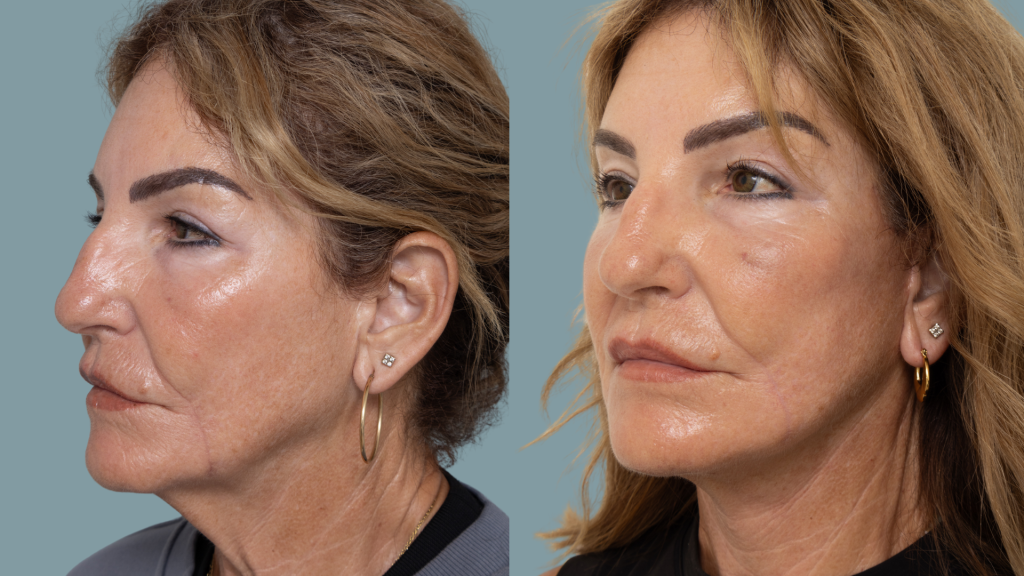
Standardised clinical photography: preoperative and 6 weeks postoperative.
Pre-operative & 6-weeks post-operative. Frontal view shown. Additional views (oblique, lateral, submental) available on request.
This result is specific to this patient. It is shown with the patient’s consent and is not a prediction of any other person’s result. Outcomes vary between individuals according to anatomy, healing and other factors. These images are taken at six weeks, when some swelling is still present and the final contour has not yet settled.
| Component | Detail |
|---|---|
| Facelift technique | Deep plane facelift with extended midface dissection |
| Neck lift technique | Deep plane, combined anterior and lateral approach |
| Platysma management | Midline plication (anterior); lateral plication |
| Cervical fixation | Mastoid crevasse fixation (lateral) |
| Digastric muscle management | Partial reduction (shaving) of digastric muscle prominence |
| Submandibular gland | No significant excess; partial removal not indicated or performed |
| Volume restoration | Structural fat grafting, multiple facial regions including left cheek |
| Brow lift | Endoscopic brow lift |
| Deep neck fat reduction | Not performed (not indicated) |
| Photography | Preoperative & 6 weeks postoperative |
AHPRA Compliance Notice: This case study is intended for general information purposes only. Individual outcomes vary, as the result experienced by one person does not necessarily reflect the result another person may experience. All surgical procedures carry risks and require a recovery period. Results shown are specific to this patient and cannot be guaranteed for others. Surgery should only be considered after thorough consultation with an appropriately qualified Specialist Plastic Surgeon, and a second opinion is encouraged. Full information on the risks of surgery and recovery is available on our risks of surgery page. This content does not constitute medical advice.
Dr David Sparks — Specialist Plastic Surgeon | FRACS (Plast.) | MED0001863770 | The Coastal Clinic, Southport QLD | Fraser-Kirk Plastic Surgery, Sunshine Coast QLD







All surgery and invasive procedures carry risks. Before proceeding, you should seek a second opinion from an appropriately qualified health practitioner. Read our full information on the risks of surgery. Dr David Sparks — Specialist Plastic Surgeon, MED0001863770.