Fraser-Kirk Plastic Surgery
Sunshine Coast
Level 3/37 The Esplanade,
Maroochydore QLD 4558
Patient profile
Age: 62 | Sex: Female | Previous surgery: SMAS face and neck lift, 15 years prior
Photography: Preoperative & 6 weeks postoperative
A facelift resets the clock; it doesn’t stop it. This case describes revision face & neck lift in a 62-year-old woman who had a SMAS-based face and neck lift 15 years earlier. In the years since, the ordinary process of facial ageing continued over the results of that first operation: heaviness returned to her lower eyelids, her nasolabial folds and marionette lines deepened, jowling reappeared along an increasingly indistinct jawline, and the sharp neck contour her original surgery had achieved gradually softened into an obtuse cervicomental angle.
The operative objectives, defined at consultation on the basis of the clinical findings set out below, were to address the lower eyelid heaviness and the abrupt lid-cheek transition, the nasolabial and marionette folds, the jowling and loss of jawline definition, and the obtuse cervicomental angle. Whether surgery was appropriate, and which of these findings could reasonably be addressed, was assessed individually for this patient.
Clinical evaluation identified the following features, reflecting both the natural progression of facial ageing and the interval since her original surgery:
The operative plan combined a deep plane face and neck lift with autologous fat grafting to the malar region and lower eyelids — again, a pairing chosen deliberately, because each element addresses a different concern. The lift addresses structural descent: it repositions the soft tissues of the face and neck that have continued to settle in the 15 years since her original surgery. The fat grafting addresses volume: it restores what has been lost from the cheek, correcting the hollow, overaccentuated transition at the lid-cheek junction that skin tightening alone cannot resolve.
Because this was a revision procedure, the choice of technique also had to account for the plane of her original surgery. Her first lift was SMAS-based — the SMAS layer itself was tightened or plicated. Fifteen years on, working in that same superficial plane offers diminishing returns: the tissue has less structural integrity to draw on, and the retaining ligaments anchoring the deeper facial structures remain unreleased and continue to limit how far the face can be repositioned. A deep plane lift moves the operation into a different, deeper anatomical plane, releasing those retaining ligaments and repositioning skin and SMAS together as a single composite unit. In this patient’s case, and given the plane of her previous surgery, this was judged the more appropriate approach than returning to the same superficial plane a second time. Technique selection is an individual clinical judgement, and outcomes depend on the anatomy being treated and on how each patient heals.
A deep plane face and neck lift was performed bilaterally. The composite flap of skin and SMAS was elevated together and the facial retaining ligaments released, allowing the flap to be repositioned as a single unit along a natural vector rather than relying on skin tension or re-plication of an already-thinned SMAS. This directly addressed the jowling, the indistinct jawline, and the nasolabial and marionette folds, restoring a smoother, more continuous contour from the cheek through to the jawline.
The paramedian platysma bands were addressed directly through platysma plication in the midline, restoring muscular continuity through the neck and correcting the visible banding present at rest and on animation. A partial resection of the platysma below the hyoid was also performed, removing excess muscle at the point where it tends to bunch once the bands are drawn together, and enhancing the definition achieved by the plication itself.
Lateral suspension was achieved through a mastoid crevasse approach. The parotid gland was elevated forward, partially off the mastoid process and sternocleidomastoid, to expose the mastoid periosteum as a fixation point. The platysma was then anchored directly to this periosteum rather than to the more superficial tissue planes, giving a considerably more robust and durable point of fixation. This complements the midline correction: where the midline plication and partial resection restore continuity and definition between the two platysma bands, the mastoid crevasse fixation anchors the muscle laterally, supporting the jawline and cervical contour and reducing the tendency for the corrected tissue to descend again over time.
A digastric shave was performed, reducing the visible bulk of the anterior belly of digastric where it contributed to fullness in the submental triangle. Left untreated, a prominent digastric muscle can blunt an otherwise well-defined cervicomental angle even after the skin and platysma have been addressed; recontouring it here supported a cleaner, more defined line beneath the chin.
Together, the midline plication with partial platysma resection, the mastoid crevasse fixation laterally, and the digastric shave corrected the combined skin and muscular laxity responsible for her obtuse cervicomental contour, re-establishing a defined angle between the chin and neck.
Fat was harvested, processed, and grafted to the malar region and lower eyelids bilaterally. Volume loss is as much a driver of the aged appearance around the eyes as skin laxity is, and skin tightening on its own does little to resolve a hollow or overaccentuated lid-cheek junction — it can even sharpen the transition further. Restoring volume in the malar region and lower eyelids softens that transition directly, blending the lower eyelid into the cheek along a smooth, continuous contour rather than leaving the abrupt step that skin surgery alone would preserve.
Operating within tissue previously addressed 15 years earlier required careful planning of the dissection to account for scar tissue and the altered anatomical planes left by the original SMAS lift. Working deeper than the original dissection allowed clean access to the retaining ligaments without compromising the plane of prior surgery.
At six weeks postoperatively, this patient demonstrated improvement across the areas targeted in the operative plan, as set out below. Surgical results continue to refine and settle beyond this early timepoint as swelling fully resolves, scars mature, and tissues soften. Outcomes vary between individuals and this result is not a prediction of any other patient’s result.
Recovery from combined face and neck lift surgery follows a general pattern, though it varies between individuals:
Face and neck lift surgery is a major surgical procedure performed under general anaesthesia, and it carries real risks. These include bleeding and haematoma — a collection of blood beneath the skin, and the most common significant complication of facelift surgery — infection, wound healing difficulties, scarring, asymmetry, changes in skin sensation, and injury to the branches of the facial nerve, which is uncommon and often temporary but can be serious. Fat grafting carries additional risks including partial resorption of the grafted fat, irregularity or overcorrection, and the possible need for further grafting. Revision surgery, where tissue has been operated on previously, involves altered anatomical planes and scar tissue, which can affect both the dissection and healing. Recovery takes weeks, not days, and further surgery is sometimes required.
A GP referral is required before a surgical consultation for cosmetic surgery, and a seven-day cooling-off period applies before proceeding. Full information on the risks of surgery and recovery is available on our risks of surgery page, and a second opinion from an appropriately qualified health practitioner is encouraged.
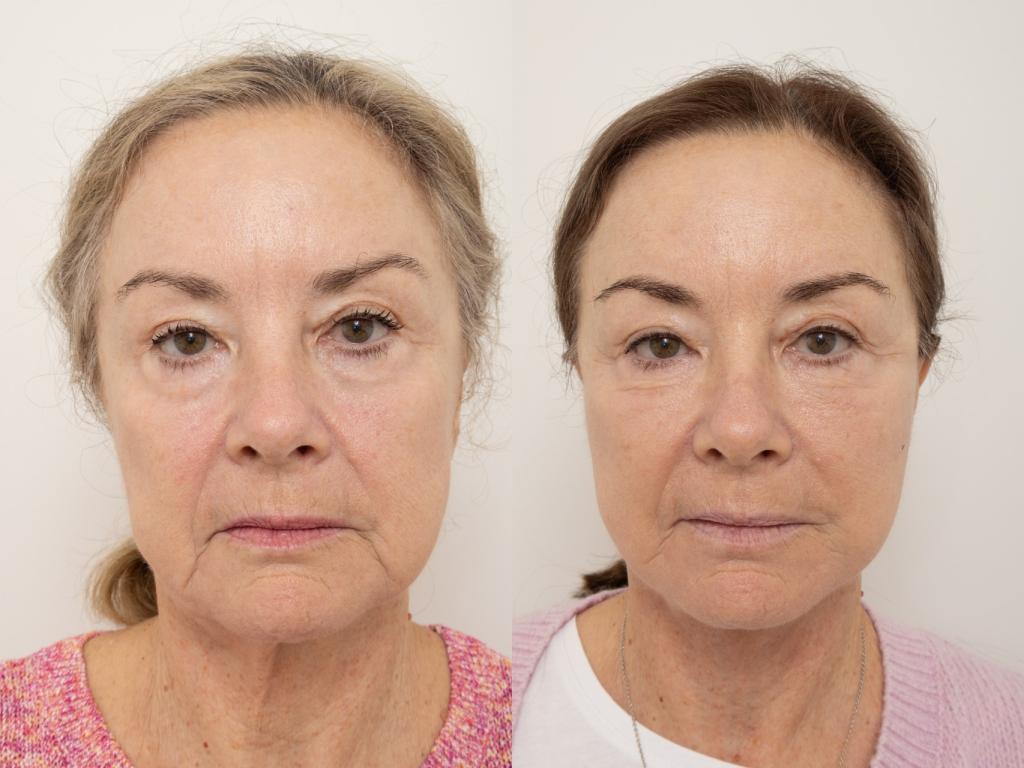
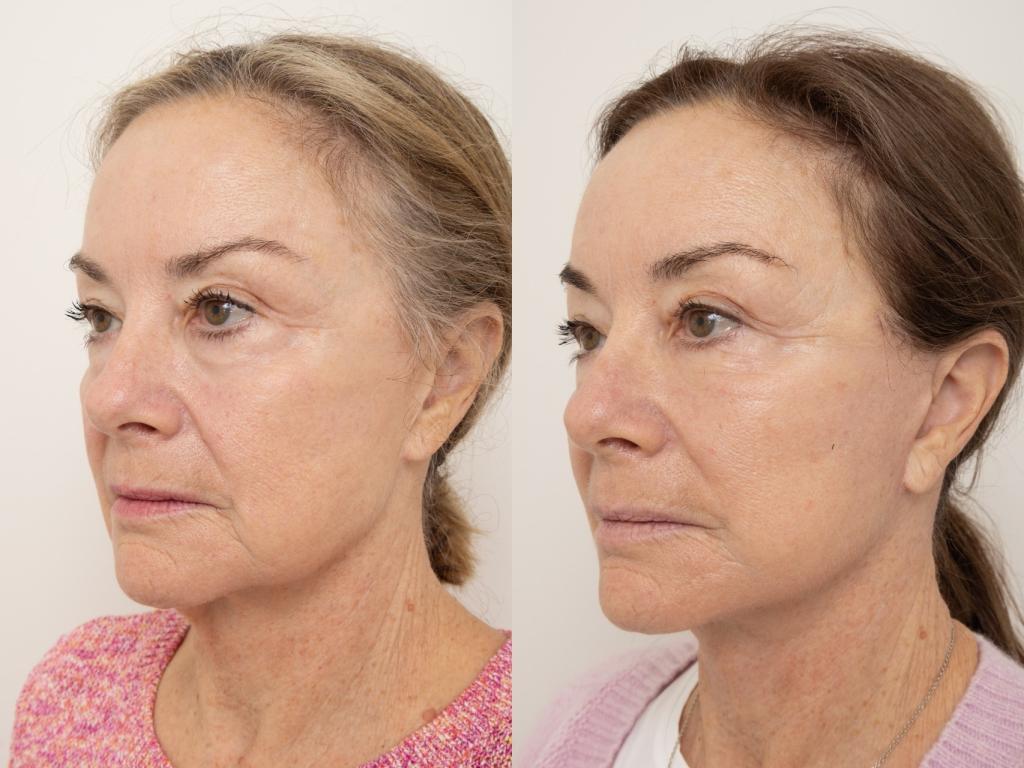
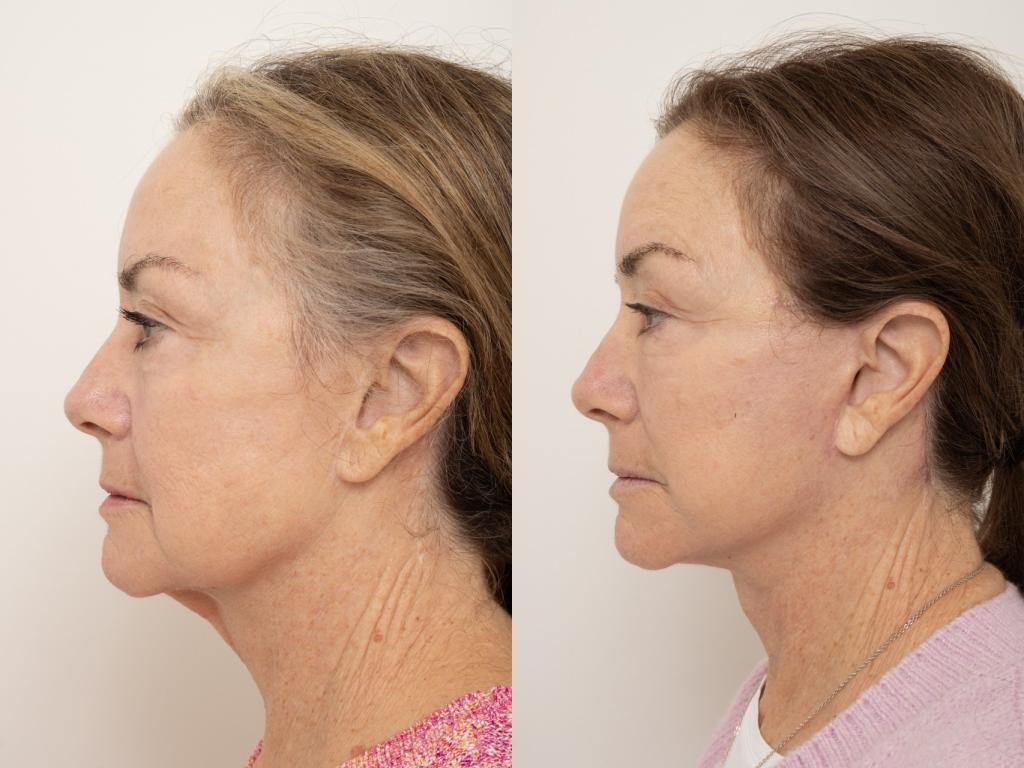
Standardised clinical photography: preoperative and 6 weeks postoperative.
Pre-operative (left) & 6-weeks post-operative (right), shown in frontal, oblique and lateral views. Images are unedited — no filters, retouching or alteration — and both were taken under standardised conditions with the same lighting, camera angle, framing and positioning.
This result is specific to this patient. It is shown with the patient’s consent and is not a prediction of any other person’s result. Outcomes vary between individuals according to anatomy, healing and other factors. These images are taken at six weeks, when some swelling is still present and the final contour has not yet settled.
| Component | Detail |
|---|---|
| Procedure | Deep plane face and neck lift with autologous fat grafting |
| Facelift technique | Deep plane |
| Neck lift technique | Deep plane |
| Platysma plication | Midline (paramedian) plication with partial platysma resection below the hyoid; lateral fixation to mastoid periosteum via mastoid crevasse plication |
| Digastric shave | Performed to refine the submental contour |
| Previous surgery | SMAS face and neck lift, 15 years prior |
| Volume restoration | Structural autologous fat grafting — malar region and lower eyelids, bilateral |
| Periorbital correction | Lid-cheek junction softened via malar and lower eyelid fat grafting |
| Photography | Preoperative & 6 weeks postoperative |
AHPRA Compliance Notice: This case study is intended for general information purposes only. Individual outcomes vary, as the result experienced by one person does not necessarily reflect the result another person may experience. All surgical procedures carry risks and require a recovery period. Results shown are specific to this patient and cannot be guaranteed for others. Surgery should only be considered after thorough consultation with an appropriately qualified Specialist Plastic Surgeon, and a second opinion is encouraged. Full information on the risks of surgery and recovery is available on our risks of surgery page. This content does not constitute medical advice.
Dr David Sparks — Specialist Plastic Surgeon | FRACS (Plast.) | MED0001863770 | The Coastal Clinic, Southport QLD | Fraser-Kirk Plastic Surgery, Sunshine Coast QLD







All surgery and invasive procedures carry risks. Before proceeding, you should seek a second opinion from an appropriately qualified health practitioner. Read our full information on the risks of surgery. Dr David Sparks — Specialist Plastic Surgeon, MED0001863770.