Fraser-Kirk Plastic Surgery
Sunshine Coast
Level 3/37 The Esplanade,
Maroochydore QLD 4558
Patient profile
Age: Late 60s | Sex: Female | Presentation: Chronic neck & shoulder pain; recurrent inframammary rash Photography: Preoperative & 6 weeks postoperative
Breast reduction sits in an unusual place in plastic surgery: it is often thought of as a cosmetic operation, yet for most of the women who seek it, the problem is weight. This case illustrates the surgical management of symptomatic breast hypertrophy in a woman in her late 60s who presented with longstanding neck and shoulder pain attributable to the load her breasts placed on her cervical spine and shoulder girdle. She had also developed a recurrent rash — intertrigo — in the inframammary folds, where skin rests against skin and moisture and friction accumulate.
Her goals were functional and clearly stated: relief of the musculoskeletal pain, resolution of the skin irritation beneath the breasts, and a breast that remained natural and in proportion to her frame.
Clinical evaluation identified the following features:
The operative plan combined a Wise pattern skin resection with a superomedial pedicle — a pairing chosen deliberately, because each element solves a different problem. The skin pattern determines the shape of the envelope; the pedicle determines where the remaining breast tissue sits and how the nipple-areola complex stays alive. Getting both right is what separates a reduction that simply removes weight from one that produces a breast the patient recognises as her own, only lighter.
A Wise pattern (inverted-T) skin resection was used to manage the skin envelope bilaterally. The value of the Wise pattern lies in control: it allows the skin to be tailored in two vectors — vertically and horizontally — so that both the excess skin length and the excess skin width are addressed directly at the time of surgery. The result is a skin envelope that fits the reduced breast immediately, draping into a natural shape on the operating table rather than relying on the skin to contract and settle over the months that follow.
This is the principal advantage over vertical-scar techniques such as the Lejour reduction, which trade scar length for shape control. Vertical techniques depend on skin retraction to resolve the gathering and pleating left at the end of the operation, and the early shape can be flat or boxy while that process runs its course. The Wise pattern accepts a longer scar in exchange for a predictable, naturally shaped breast from the outset — a trade that, in my practice, patients consistently consider worthwhile.
The nipple-areola complex and the retained breast tissue were carried on a superomedial pedicle. This pedicle draws its blood supply from perforating branches of the internal mammary artery — a robust and consistent source — giving the nipple-areola complex an optimal vascular foundation as it is repositioned.
Just as importantly, the superomedial pedicle governs where the remaining breast tissue ends up. By design, it concentrates the retained tissue superiorly and medially, preserving fullness in the upper pole and the medial cleavage area — precisely the regions where volume loss is most noticeable and most difficult to correct later. The breast is not simply made smaller; the tissue that remains is positioned where it contributes most to the final shape.
In selected cases a superior pedicle is used instead — typically where a previous reduction has been performed, or where the nipple position is already quite high. In these circumstances the superior pedicle affords greater control over the final nipple position and the safety of the tissue rearrangement.
Approximately 200 g of breast tissue was removed from each breast, with resection weights compared intraoperatively to support symmetry. The reduction was calibrated to relieve the load responsible for her symptoms while preserving a breast proportionate to her frame.
As in every breast reduction, all resected tissue was sent for histopathological examination. This is a routine and non-negotiable step: reduction specimens occasionally harbour unexpected findings, including incidental breast cancer, and formal examination of the tissue ensures that nothing clinically significant goes undetected. The results were reviewed and discussed with the patient — fortunately nothing unusual in this case.
At six weeks postoperatively, the patient demonstrated meaningful improvement across all targeted areas. Surgical results continue to refine and settle beyond this early timepoint as swelling fully resolves, scars mature, and tissues soften.
Standardised clinical photography: preoperative and 6 weeks postoperative.
PREOPERATIVE
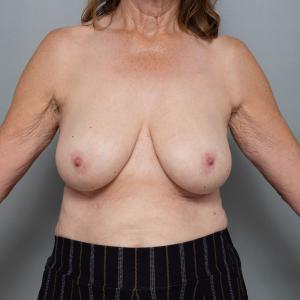
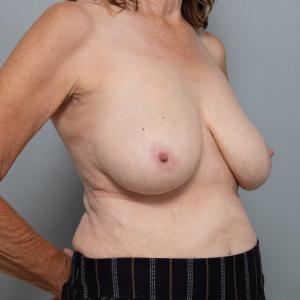
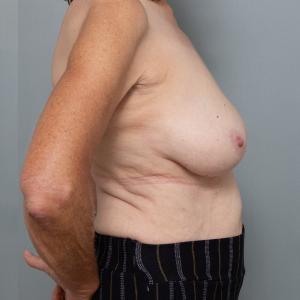
6 WEEKS POSTOPERATIVE
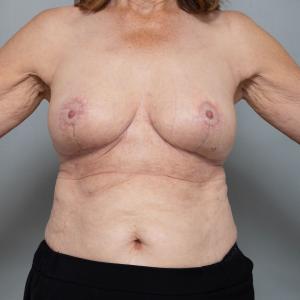
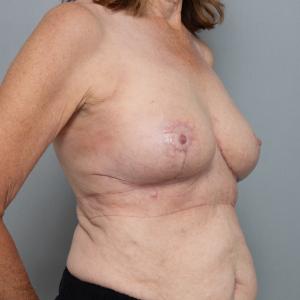
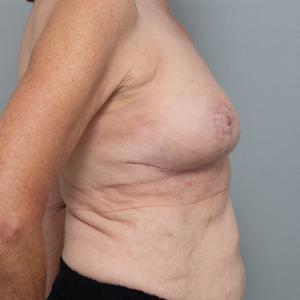
Frontal, oblique and lateral views shown, in the same order before and after.
| Component | Detail |
|---|---|
| Procedure | Bilateral breast reduction |
| Skin pattern | Wise pattern (inverted-T) |
| Pedicle | Superomedial |
| Alternative pedicle | Superior — in selected cases (e.g. previous reduction, high nipple position) |
| Resection weight | Approximately 200 g per breast (total ~400 g) |
| Histopathology | Routine — all resected tissue examined |
| Photography | Preoperative & 6 weeks postoperative |
AHPRA Compliance Notice: This case study is intended for general information purposes only. Individual outcomes vary, as the result experienced by one person does not necessarily reflect the result another person may experience. All surgical procedures carry risks and require a recovery period. Results shown are specific to this patient and cannot be guaranteed for others. Surgery should only be considered after thorough consultation with an appropriately qualified Specialist Plastic Surgeon, and a second opinion is encouraged. Full information on the risks of surgery and recovery is available on our risks of surgery page. This content does not constitute medical advice.
Dr David Sparks — Specialist Plastic Surgeon | FRACS (Plast.) | MED0001863770 | The Coastal Clinic, Southport QLD | Fraser-Kirk Plastic Surgery, Sunshine Coast QLD







All surgery and invasive procedures carry risks. Before proceeding, you should seek a second opinion from an appropriately qualified health practitioner. Read our full information on the risks of surgery. Dr David Sparks — Specialist Plastic Surgeon, MED0001863770.