Fraser-Kirk Plastic Surgery
Sunshine Coast
Level 3/37 The Esplanade,
Maroochydore QLD 4558
Why volume restoration is part of the operation rather than an addition to it. There’s a version of facelift surgery that lifts the face. And there’s a version that restores it. The difference, more often than not, comes down to fat. We’ve understood for decades that facial ageing isn’t simply a matter of descent, things […]
There’s a version of facelift surgery that lifts the face. And there’s a version that restores it.
The difference, more often than not, comes down to fat.
We’ve understood for decades that facial ageing isn’t simply a matter of descent, things falling south under the influence of gravity. It’s also a matter of deflation. The fat compartments of the face atrophy differentially with age, volume redistributes unpredictably, bony remodelling changes the scaffolding beneath the soft tissue, and the skin itself loses the intrinsic quality that once made it resilient. A deep plane facelift (rhytidectomy) addresses descent beautifully. But if deflation isn’t simultaneously addressed, the result is a face that’s been repositioned but not rejuvenated: tighter, perhaps, but still hollow, still flat, still missing something.
This is why structural fat grafting has become, for me, an inseparable component of every deep plane face and neck lift I perform. Not as an add-on. Not as an afterthought. As a foundational part of what it means to comprehensively restore a face.
The deep plane facelift addresses descent by releasing the SMAS from its ligamentous attachments and repositioning the facial soft tissue in the anatomical direction it descended from. It restores structural relationships. But repositioning alone doesn’t restore volume, and it doesn’t improve skin quality. For that, you need fat.
Combining facelift surgery with fat grafting is an established means of addressing age-related ptosis and volume loss in the same operative episode, and it addresses both processes of ageing rather than one of them.
The reason fat is uniquely suited to this role, as opposed to fillers, implants, or other augmentation tools, is that it’s biologically alive. Autologous fat isn’t inert filler. It’s tissue. It contains mature adipocytes, stromal vascular fraction, adipose-derived stem cells, endothelial progenitor cells, growth factors, and extracellular matrix components. Where a graft takes, it becomes part of the recipient site rather than remaining a discrete deposit within it — moving with the face and behaving as the tissue around it does.
Transplanted fat is, initially, avascular. Survival in the first critical days depends on passive diffusion of oxygen and nutrients from the surrounding recipient tissue. The graft must revascularise quickly; new capillary ingrowth must reach the transplanted adipocytes before ischaemia causes irreversible cell death. This is why recipient site vascularity is one of the most important determinants of graft survival, and why placement decisions matter enormously.
Adipose-derived stem cells within the graft support survival through growth factor secretion, immunomodulation, intercellular mitochondrial transfer, and exosomal signalling that coordinates angiogenesis, inflammation, and fibrosis. The stromal vascular fraction of adipose tissue, the non-adipocyte component, is doing as much biological work as the adipocytes themselves. Fat isn’t just filler. It’s a regenerative biological depot.
The reported survival rate of grafted fat ranges from 20 to 80 percent, a wide range that reflects enormous variability in technique, processing, particle size, placement depth, and recipient site biology. Reducing that variability through disciplined, evidence-informed technique is where the surgeon’s role is most consequential. It does not eliminate it: retention varies between individuals, and no volumetric result can be guaranteed.
Processing matters, and the evidence is clear that centrifugation of harvested fat, separating it from the aqueous phase of blood and tumescent fluid and from the oil phase of lysed adipocytes, is superior to simple decantation in terms of graft viability and retention.
There is, however, a ceiling. There’s a linear reduction in adipocyte viability with increasing centrifugal force, and histologically significant distortion and fracture of adipocytes occurs when centrifugal speed reaches and exceeds 4000 rpm. The Coleman technique, approximately 1200 to 1500g for three minutes, remains the most widely used and best-supported benchmark, maintaining adipocyte viability through effective separation without mechanical destruction. More recent work suggests speeds in the range of 1200 to 1300g may provide an optimal balance between concentration efficacy and cell preservation, particularly when combined with gentle low-pressure harvesting technique, and are associated with better preservation of progenitor cell populations within the stromal vascular fraction.
My processing approach sits within this evidence-based range. After centrifugation, I move immediately to the next step, because time is also a variable. Fat that sits processed but uninjected deteriorates. The adipocytes are ischaemic from the moment of harvest. Every minute between processing and placement represents additional cell stress and reduced viability.
For micronisation, I use the disposable Samson Adinizer, a purpose-built mechanical emulsification system that produces consistent, reproducible particle sizes through standardised filter connectors. The key advantage of a standardised disposable system is reproducibility: the same emulsification force is applied each time, producing consistent particle size distributions across procedures and patients.
My fat grafting system uses two fractions, 1200 micron and 600 micron, rather than three. This reflects my current thinking on the evidence base for particle size, vascularisation, and optimising fat graft take, and it simplifies the technical workflow without compromising the biological outcomes.
Why two fractions rather than three? The distinction between a traditional “macrofat” fraction at 2400 microns and a “microfat” fraction at 1200 microns has intuitive appeal, but the evidence for superior graft survival of the larger particle fraction in the facial context is less compelling than it might appear. What the evidence does support strongly is the relationship between particle size, surface-area-to-volume ratio, and vascularisation: smaller particles have proportionally more surface area in contact with the recipient tissue per unit of volume, which supports faster and more uniform revascularisation. A 1200 micron particle achieves this advantage over a 2400 micron bolus without requiring the more extreme emulsification that produces 600 micron nanofat, preserving viable adipocytes and the capacity for genuine volumetric restoration while optimising the conditions for graft take.
The 1200 micron fraction is therefore the workhorse of my structural fat grafting programme. It’s capable of meaningful volumetric restoration, providing the structural augmentation traditionally attributed to macrofat, while its smaller particle size and superior surface-area-to-volume ratio make it better suited to the variable recipient environments of the face than larger bolus grafting. In anatomically delicate regions where traditional thinking called for “microfat,” the sub-brow, the lower eyelid-cheek junction, the malar subcutaneous plane, the 1200 micron fraction handles both roles without compromise.
I inject immediately after micronisation, without exception. The emulsification process introduces mechanical stress to the adipocytes, and allowing emulsified fat to sit allows the cellular contents of disrupted cells to contaminate the viable stromal fraction. Immediate injection maximises the regenerative potential of what’s been prepared.
1200 micron fat: structural volume and precise intermediate grafting. The 1200 micron fraction is my single structural grafting material for all volumetric restoration across the face. Its particle size achieves the surface-area-to-volume ratio that supports reliable revascularisation while maintaining sufficient adipocyte integrity for lasting volume. I use it for all applications where volume restoration is the primary goal.
For deep structural augmentation, the subperiosteal tear trough along the inferior orbital rim, the deep midface against the anterior maxilla, and jawline grafting in male patients along the mandibular body and angle, the 1200 micron fraction is placed against a well-vascularised periosteal or deep supra-periosteal bed, which is the placement most likely to support graft take.
For intermediate depth augmentation, the sub-brow region correcting temporal hollowing and brow deflation, the lower eyelid-cheek junction addressing the transition between the malar fat pad and the lower lid fat compartments, and subcutaneous malar augmentation, the same 1200 micron fraction is placed in the subdermal and subcutaneous planes. The particle size is appropriate for these thinner, more mobile recipient environments.
This single-fraction approach to structural grafting simplifies the intraoperative workflow and reduces the total processing time, which, given the importance of minimising ischaemic time between harvest and placement, is not a trivial advantage.
600 micron nanofat: skin quality. The 600 micron nanofat fraction is produced through the full emulsification cycle of the Adinizer, which disrupts the cell membranes of most viable adipocytes and produces a fine suspension rich in stromal vascular fraction, adipose-derived stem cells, growth factors, and extracellular matrix components. Nanofat doesn’t restore volume in any meaningful sense, the adipocytes have been disrupted, but it delivers a concentrated regenerative cellular payload to the tissue it’s placed in.
Placed intradermally and subdermally, nanofat is used with the aim of improving skin texture, fine rhytid depth, pigmentation and dermal quality over the months following placement. The proposed mechanism is the biological activity of the stromal vascular fraction: stimulating fibroblast activity, promoting neovascularisation through VEGF and FGF signalling, supporting new collagen synthesis, and modulating the inflammatory milieu of the ageing dermis. The evidence base for this is still developing, and the degree of change differs considerably between individuals.
I deploy nanofat in three specific anatomical zones.
The periorbital region, the lower eyelid skin, the lateral canthal area, and the periorbital zone, is where I use it most. The skin in this region is the thinnest on the face, ages earliest and most visibly, and has a limited tolerance for volumetric fat injection. Intradermal nanofat placed through a fine cannula in multiple passes is an approach to this skin that volumetric grafting can’t safely take.
The perioral region and lips, where fine vertical lip lines, lip border blurring, and radial rhytids are common concerns, are treated with intradermal nanofat placed at the lip border and in the superficial dermis of the upper and lower lip.
The anterior neck is perhaps the most underutilised nanofat application in facelift surgery. After platysmal management and skin excision have addressed the structural neck, the skin of the anterior neck carries its full burden of accumulated quality changes: crepiness, texture irregularity, fine lines. Intradermal nanofat targets the surface quality of that skin, which the structural work does not address.
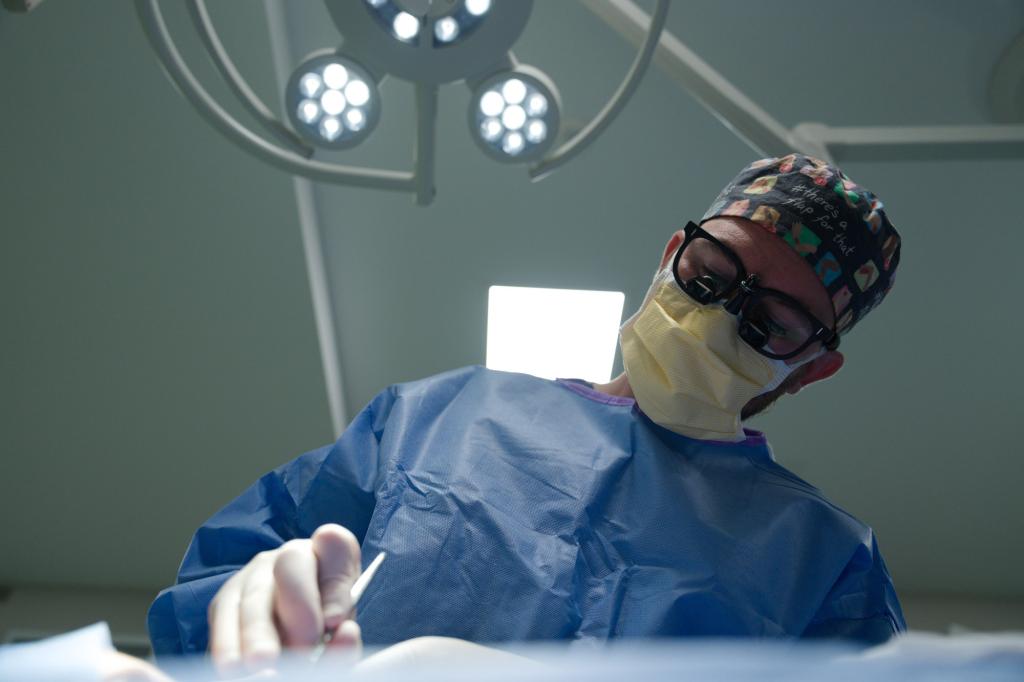
I perform all fat grafting at the beginning of the operative case, before the deep plane dissection and flap elevation. The reasoning is straightforward.
The recipient tissue at the start of the case is in its most physiologically intact state. The vascularity is undisturbed. The deep plane dissection, by releasing the facial ligaments and elevating the composite flap, inevitably disrupts some of the local vascularity in the recipient zone. Grafting into tissue that’s already undergone this dissection means grafting into a temporarily compromised vascular bed. Grafting first, into undisturbed, well-vascularised tissue, gives the fat the best possible environment for early diffusion and subsequent revascularisation.
Additionally, the facelift dissection itself then applies gentle mechanical stimulation to the grafted areas as the flap is elevated and repositioned, and there’s emerging evidence that early mechanical stimulation of a recipient site may enhance angiogenic signalling. Whether or not this effect is clinically significant, the principle of grafting first is biologically sound and logistically efficient.
There’s no standardised fat grafting protocol that applies uniformly to every patient. The volumes, locations, and depths I use vary considerably based on each individual’s anatomy: the pattern and degree of fat compartment depletion, the quality and thickness of the skin, the underlying skeletal structure, and the specific aesthetic goals of the case.
A male patient seeking jawline definition and malar structure gets a very different plan to a female patient in her sixties with significant periorbital hollowing and perioral skin quality concerns. What’s consistent is the technical framework: harvest gently, centrifuge at an evidence-based speed, micronise with the Adinizer to the appropriate fraction, inject immediately. What’s placed where, in what volumes, at what depth, is bespoke every time.
This is what I mean when I describe my approach as structural: it’s not filling space indiscriminately. It’s restoring specific anatomical compartments with the right material at the right depth, planned as carefully as any other element of the surgical case.
A facelift that lifts without addressing volume is addressing one half of the ageing process. Structural fat grafting addresses the other half. The two-fraction approach, 1200 micron for structural volume at every depth, 600 micron nanofat for skin, achieves this in a technically streamlined system that prioritises what the evidence supports: particle size appropriate for vascularisation, immediate injection after processing, and placement into the most favourable recipient environment available.
What that produces in any individual patient depends on their anatomy, their fat and how they heal. Retention varies between patients and cannot be guaranteed, and what is appropriate can only be assessed in consultation.
Fat is the tissue the face lost. Giving it back isn’t a trick. It’s anatomy.
Facelift surgery is a major surgical procedure performed under general anaesthesia, and it carries real risks, which are discussed with you in full at consultation and again before surgery. Complications can include bleeding, haematoma — a collection of blood beneath the skin, and the most common significant complication of facelift surgery — infection, wound healing difficulties, scarring, asymmetry, changes in skin sensation, and injury to the branches of the facial nerve, which is uncommon and often temporary but can be serious.
Fat grafting carries its own risks in addition to those. These include unpredictable and partial resorption of the grafted fat, asymmetry, contour irregularity, palpable lumps or nodules, fat necrosis and oil cyst formation, infection, and the possible need for further grafting or revision. Donor site complications — bruising, contour irregularity and discomfort — also occur. Rarely, fat injected in the face can enter a blood vessel, which is a serious complication. Retention rates vary considerably between individuals and no volumetric result can be guaranteed.
Recovery takes weeks rather than days, and further surgery is sometimes required. Outcomes vary between individuals according to anatomy, healing and other factors.
Before proceeding, a referral from your GP or another registered medical practitioner is required, and a seven-day cooling-off period applies. All of this will be discussed with you carefully in advance.
I consult at The Coastal Clinic on the Gold Coast and Fraser-Kirk Plastic Surgery on the Sunshine Coast. If you are considering facial surgery and would like to discuss what would be involved for you specifically, I welcome an initial consultation.
Dr David Sparks — MBBS(Hons) MS(Plast) PhD FRACS(Plast) — Specialist Plastic Surgeon, MED0001863770
All surgery and invasive procedures carry risks. Before proceeding, you should seek a second opinion from an appropriately qualified health practitioner.







All surgery and invasive procedures carry risks. Before proceeding, you should seek a second opinion from an appropriately qualified health practitioner. Read our full information on the risks of surgery. Dr David Sparks — Specialist Plastic Surgeon, MED0001863770.