Fraser-Kirk Plastic Surgery
Sunshine Coast
Level 3/37 The Esplanade,
Maroochydore QLD 4558
A technique for managing dead space after facelift dissection, and what the evidence behind it now shows. Every surgeon performing facelift surgery is managing the same fundamental tension. The more comprehensive the procedure, the more dissection required, and the more dissection required, the greater the potential for postoperative complications. Haematoma, bleeding beneath the skin flap, […]
Every surgeon performing facelift surgery is managing the same fundamental tension. The more comprehensive the procedure, the more dissection required, and the more dissection required, the greater the potential for postoperative complications. Haematoma, bleeding beneath the skin flap, is the most significant and most feared of these. It can compromise flap survival, drive reoperation, prolong recovery, and in worst-case scenarios lead to skin necrosis. Managing that risk without compromising the quality or completeness of the surgical result is one of the central technical challenges of facelift surgery (rhytidectomy).
The haemostatic net is one of the most important tools I use to address it. It is a technique still relatively unfamiliar to many patients, and to some practitioners, but the evidence base behind it is now substantial, and it has been part of my standard practice for some time. This article explains what it is, what it does, and why.
The haemostatic net is a technique in which fine continuous sutures, typically a 5-0 monofilament, are placed transcutaneously across the dissected area following skin flap elevation and closure. The needle passes perpendicular through the skin surface and engages the underlying SMAS-platysma layer at approximately 45 degrees. Suture passages are spaced around 0.8 to 1 centimetre apart and arranged in parallel lines covering the entire dissected region. The net is applied with moderate, uniform tension: enough to obliterate the dead space created by the dissection, but not so tight as to compromise the blood supply of the skin flap.
The net is then left in place for 48 to 72 hours postoperatively and removed at the bedside. It takes its name from the grid-like appearance it creates across the face and neck during that period, something I explain to every patient clearly before surgery so it is expected rather than alarming.
The technique was originally described by Auersvald and Auersvald in Brazil and has since been adopted across multiple surgical centres internationally, across a range of facelift techniques, from SMAS plication to lateral deep plane and extended deep plane approaches.
The haemostatic net works through a simple and mechanically coherent principle. By anchoring the skin flap to the underlying tissue in a grid-like pattern, it eliminates the dead space that would otherwise exist between the elevated flap and the deeper structures. Dead space is where haematoma and seroma accumulate. Remove the space, and you substantially reduce the opportunity for fluid to collect.
Beyond haemostasis, the net does a second piece of mechanical work. The transcutaneous sutures fix the skin to the underlying soft tissue in a controlled and vector-specific manner, which helps drape and adapt the skin flap in the intended anatomical position. Along the jawline in particular, it holds the redraped skin against the underlying tissue in the position it was set. The net essentially acts as an internal mould, holding the repositioned tissue in place while the early healing process begins to establish the new soft tissue relationships.
The evidence base for the haemostatic net has matured considerably. A 2026 systematic review and meta-analysis published in the Journal of Plastic, Reconstructive and Aesthetic Surgery, drawing on data from eight studies encompassing 1,617 patients, evaluated the efficacy and safety of the haemostatic net across facelift, browlift and necklift procedures. The primary outcome was haematoma incidence, observed at a rate of 0.14 per 100 patients (95% CI 0.00 to 0.58), a low pooled rate across the cohort.
The secondary outcomes were consistent with it. Seroma occurred at 2.16 per 100, necrosis at 0.36 per 100, ischaemia at 1.10 per 100, and infection at 0.62 per 100, all minimal incidences across the included studies.
The one cosmetic consideration patients sometimes ask about is the temporary marks left by the sutures on the skin surface. The incidence of hyperaemic marks associated with the haemostatic net was 12.70 per 100, but critically, none of these cases progressed to persistent hyperpigmentation, and the marks resolved completely within two to three months. That is consistent with my own practice: the marks are an expected and temporary feature of the technique, not a complication, and their resolution is predictable when the net is removed at the appropriate time.
No sensory deficits were identified in the evaluated patients, with an incidence of 0 per 100 across the studies that assessed this outcome. That is an important finding. Placing multiple transcutaneous sutures could theoretically raise concern about superficial sensory nerve compression, and the evidence provides clear reassurance that the concern is not borne out in practice.
The review authors noted that the haemostatic net may reduce the need for drains, decrease reoperation rates due to haematoma, and potentially improve postoperative recovery. They concluded that it should be viewed as a valuable complementary tool in surgical decision-making for selected facelift patients.
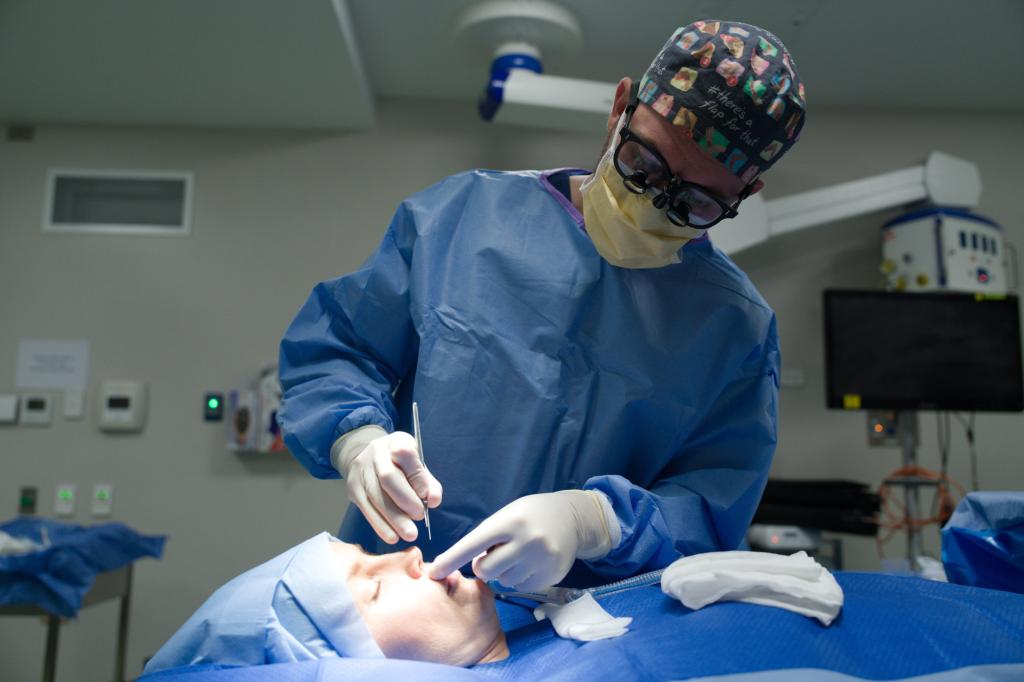
This is the question any thoughtful surgeon must ask when considering a technique that involves placing sutures through a freshly elevated skin flap. Tight sutures in the wrong location, at the wrong tension, could theoretically compress the subdermal vascular plexus and compromise flap perfusion, leading to ischaemia or necrosis.
The answer, supported by dedicated experimental evidence, is that the haemostatic net does not adversely affect skin perfusion when applied correctly.
A cadaveric anatomical and radiological study published in Aesthetic Surgery Journal by Henry, Auersvald, Auersvald, Ospital, Boucher and Mojallal, conducted at the University of Lyon using fourteen fresh cadaver hemifaces undergoing deep plane facelift dissection, investigated the question directly. The anatomic and radiologic techniques enabled visualisation of the arterial system reaching the subdermal vascular plexus and branching between the vascular territories, without interference from the net. The sequential dye perfusion study performed on ten hemifaces demonstrated staining in each facelift flap, with comparable coloration distributions before and after application of the net. The haemostatic net did not affect the skin blood supply, correlating with no clinical increases in ischaemia and necrosis rates in the facelift flap.
The study identified a mechanistic explanation. The net may have a beneficial effect on perfusion by distributing transverse tension more evenly across the flap surface, and by closing the dead space it may reduce compression on the subdermal vascular plexus from accumulated fluid. The net facilitates revascularisation of the flap through the underlying tissue by promoting neoangiogenesis and inosculation, processes consistent with what is understood about how skin grafts and composite flaps revascularise from their recipient beds.
That vascular data provides the mechanistic underpinning for what the clinical data already shows: low rates of ischaemia and necrosis in large patient series using the haemostatic net, consistent across multiple surgical centres and techniques.
I incorporate the haemostatic net as a standard component of my deep plane facelift approach. After completing the deep plane dissection, platysma work, fat grafting and skin closure, the net is applied across the dissected face and neck using fine 5-0 monofilament sutures in a continuous helical pattern, from the submental region and anterior neck through to the retroauricular and postauricular areas, at consistent spacing and moderate uniform tension.
The tension applied is deliberate and standardised: sufficient to eliminate dead space and fix the skin to the underlying tissue in the intended position, never so tight as to blanch the skin or compromise circulation. The spacing between suture lines, approximately one centimetre, is selected based on the published evidence for dead space obliteration while preserving perfusion.
I remove the net between 48 and 72 hours postoperatively. That interval reflects the balance between maintaining haemostatic benefit through the highest-risk early postoperative period and avoiding prolonged skin compression. Patients are counselled before surgery about the appearance of the net during that period so there are no surprises. The temporary marks that remain after removal are explained as an expected, self-resolving feature, not a sign that anything has gone wrong.
Beyond haematoma prevention, the net does mechanical work I want done along the jawline, where controlled fixation holds the redraped skin against the underlying tissue while healing begins.
One consideration worth noting is that patients with darker skin types, Fitzpatrick V and VI, may be at somewhat higher risk of prolonged hyperaemic marks or pigmentary change from the sutures. The haemostatic net in Asian populations has been studied, with authors raising considerations regarding hyperpigmentation risk, which they attributed primarily to suture size and needle choice rather than the technique itself. In practice, for patients with higher Fitzpatrick skin types, I discuss the consideration explicitly in consultation and factor it into technique selection for the net’s application in those regions.
Facelift surgery involves significant soft tissue dissection, and managing the dead space that creates is one of the non-negotiable demands of the operation. The haemostatic net addresses it directly, with published haematoma rates under 0.2 per 100 patients across more than 1,600 cases, no demonstrated compromise of skin perfusion, no sensory deficit identified in the pooled data, and no progression of the temporary marks to persistent hyperpigmentation.
It also does mechanical work I want done: holding the skin against the repositioned deep anatomy while early healing begins. That is why it is part of my standard approach.
Facelift surgery is a major surgical procedure performed under general anaesthesia, and it carries real risks, which are discussed with you in full at consultation and again before surgery. Complications can include bleeding, haematoma — a collection of blood beneath the skin, and the most common significant complication of facelift surgery — infection, wound healing difficulties, scarring, asymmetry, changes in skin sensation, and injury to the branches of the facial nerve, which is uncommon and often temporary but can be serious.
The haemostatic net itself leaves temporary marks on the skin while it is in place and for a period after removal. In the published data these resolved within two to three months, but pigmentary change is a higher consideration in darker skin types. Seroma, ischaemia and skin necrosis remain possible complications of facelift surgery whether or not the net is used.
Recovery takes weeks rather than days, and further surgery is sometimes required. Outcomes vary between individuals according to anatomy, healing and other factors.
Before proceeding, a referral from your GP or another registered medical practitioner is required, and a seven-day cooling-off period applies. All of this will be discussed with you carefully in advance.
I consult at The Coastal Clinic on the Gold Coast and Fraser-Kirk Plastic Surgery on the Sunshine Coast. If you are considering facial surgery and would like to discuss what would be involved for you specifically, I welcome an initial consultation.
Dr David Sparks — MBBS(Hons) MS(Plast) PhD FRACS(Plast) — Specialist Plastic Surgeon, MED0001863770
All surgery and invasive procedures carry risks. Before proceeding, you should seek a second opinion from an appropriately qualified health practitioner.







All surgery and invasive procedures carry risks. Before proceeding, you should seek a second opinion from an appropriately qualified health practitioner. Read our full information on the risks of surgery. Dr David Sparks — Specialist Plastic Surgeon, MED0001863770.