Fraser-Kirk Plastic Surgery
Sunshine Coast
Level 3/37 The Esplanade,
Maroochydore QLD 4558
Patient profile
Age: Early 70s | Sex: Female | Previous surgery: Neck lift (>20 years prior)
Photography: Preoperative & 6 weeks postoperative
This case describes the surgical management of age-related change in the lower face and neck in a woman in her early 70s, who presented with lower facial descent, midface volume loss, and an undefined neck contour, together with anterior cervical scarring from a neck lift performed more than two decades earlier. Her prior surgery, combined with the degree of anatomical change, called for a carefully considered operative plan.
The patient had been dissatisfied with the outcome of her original neck lift, and was particularly concerned about the residual anterior neck scarring, ongoing skin laxity, and the absence of a defined cervicomental angle. The areas she wished to address were the contour of the jawline, the platysmal banding through the neck, and the residual skin excess.
Detailed clinical evaluation identified the following features:
The surgical plan was designed to address each component of facial and cervical ageing in a layered, anatomically precise fashion. Given the patient’s prior neck surgery, particular care was taken in planning the cervical dissection to account for potential anatomical distortion from previous scarring.
The absence of significant deep cervical fat accumulation meant that deep neck fat reduction was not indicated; the operative focus was directed instead toward muscular recontouring, skin re-draping, and vector optimisation.
A SMAS plication facelift technique was performed bilaterally. The superficial muscular aponeurotic system was plicated to reposition descended facial soft tissues, support the line of the jawline, and address jowling, with an appropriate vector of lift.
In patients over 70, particularly those with facial soft tissue atrophy, the SMAS becomes progressively thinner and less robust with age. Flap elevation in this setting carries a meaningful risk of inadvertent buttonholing or tearing of the SMAS, which compromises the structural integrity of the layer and the hold of suspension sutures placed into attenuated tissue. SMAS plication — imbrication of the SMAS in situ without flap elevation — avoids this risk. By suturing the SMAS upon itself, the technique recruits the full thickness of available tissue at the suture points and avoids the dissection plane where injury is most likely in thin or atrophic patients. The modest reduction in tissue mobilisation compared with a high-SMAS or composite flap approach is offset by the reduced risk profile in this demographic. In this patient — a woman in her early 70s with facial soft tissue atrophy consistent with her age — SMAS plication was the deliberate operative choice.
A deep plane neck lift was performed, allowing release and repositioning of the deeper cervical soft tissue structures. This technique, combined with careful management of the previously scarred anterior neck, enabled comprehensive recontouring of the cervical region without relying solely on skin tension for the result.
The dehisced platysma bands were identified and re-approximated in the midline using central platysma plication. This step directly addressed the visible anterior neck banding and restored muscular continuity, creating a defined midline neck contour.
Hyoid fixation was performed to anchor the cervicomental soft tissues in their corrected position, supporting the definition of the cervicomental angle and reducing the risk of inferior descent of the corrected tissues over time. This technical step was central to achieving and maintaining the 90-degree cervicomental contour.
Lateral suspension was achieved through mastoid crevasse fixation, providing durable anchoring of the repositioned lateral neck and lower facial tissues to the mastoid periosteum. This contributed to the maintained definition of the jawline and the overall vector of the neck result.
Structural fat grafting was performed to both malar regions to address midface volume deficiency. Fat was harvested, processed by micronisation to 1,200 rpm, and 4 cc was grafted to each side. Micronised grafting technique facilitates more homogeneous distribution and optimises graft take, contributing to volume restoration in the cheek.
A brow lift was not performed, as the patient’s brow position and upper facial aesthetics did not indicate intervention at this stage.
At six weeks postoperatively, change was visible across the targeted areas. It is important to note that facial surgical results continue to settle beyond this early timepoint as swelling resolves and tissues mature.
No deep neck fat reduction was required and none was performed; the neck contour result was achieved through muscular recontouring, suspension, and skin re-draping alone. The anterior cervical scarring from the prior neck lift has been incorporated into the revised surgical approach and is continuing to mature.
Recovery from combined face and neck lift surgery follows a general pattern, though it varies between individuals:
A GP referral is recommended before a surgical consultation, and a cooling-off period applies before proceeding with cosmetic surgery. All surgery carries risk; full information on the risks of surgery and recovery is available here, and a second opinion from an appropriately qualified health practitioner is encouraged.
Standardised clinical photography: preoperative and 6 weeks postoperative.
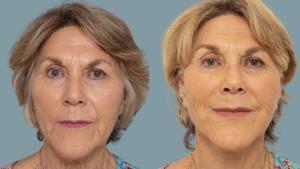
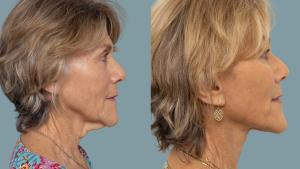
Pre-operative & 6-weeks post-operative. Additional views (oblique, lateral, submental) available on request.
This result is specific to this patient. It is shown with the patient’s consent and is not a prediction of any other person’s result. Outcomes vary between individuals according to anatomy, healing and other factors. These images are taken at six weeks, when some swelling is still present and the final contour has not yet settled.
| Component | Detail |
|---|---|
| Facelift technique | SMAS plication |
| Neck lift technique | Deep plane |
| Platysma management | Central plication |
| Cervical fixation | Hyoid fixation; mastoid crevasse fixation (lateral) |
| Deep neck fat reduction | Not performed (not indicated) |
| Volume restoration | Structural fat grafting, malar regions bilateral |
| Fat graft volume | 4 cc per side (total 8 cc) |
| Fat processing | Micronised, 1,200 rpm |
| Brow lift | Not performed |
| Photography | Preoperative & 6 weeks postoperative |
AHPRA Compliance Notice: This case study is intended for general information purposes only. Individual outcomes vary, as the result experienced by one person does not necessarily reflect the result another person may experience. All surgical procedures carry risks and require a recovery period. Results shown are specific to this patient and cannot be guaranteed for others. Surgery should only be considered after thorough consultation with an appropriately qualified Specialist Plastic Surgeon, and a second opinion is encouraged. Full information on the risks of surgery and recovery is available on our risks of surgery page. This content does not constitute medical advice.
Dr David Sparks — Specialist Plastic Surgeon | FRACS (Plast.) | MED0001863770 | The Coastal Clinic, Southport QLD | Fraser-Kirk Plastic Surgery, Sunshine Coast QLD







All surgery and invasive procedures carry risks. Before proceeding, you should seek a second opinion from an appropriately qualified health practitioner. Read our full information on the risks of surgery. Dr David Sparks — Specialist Plastic Surgeon, MED0001863770.