Fraser-Kirk Plastic Surgery
Sunshine Coast
Level 3/37 The Esplanade,
Maroochydore QLD 4558
Understanding the anatomical distinction that shapes facelift outcomes. When patients come to me having already researched facelift surgery, they often arrive with a specific question: what is the difference between a deep plane facelift and an SMAS facelift? It is a good question, and one that deserves a clear, anatomically grounded answer — because the […]
When patients come to me having already researched facelift surgery, they often arrive with a specific question: what is the difference between a deep plane facelift and an SMAS facelift? It is a good question, and one that deserves a clear, anatomically grounded answer — because the distinction matters, and not everyone explaining it online has the surgical background to do so accurately.
This post explains the anatomy, the difference between the techniques, and why that difference has a meaningful effect on how the face is repositioned.
Beneath the skin of the face lies a series of anatomical layers. Immediately deep to the skin is a layer of subcutaneous fat. Deep to that fat sits a fibromuscular structure called the superficial musculoaponeurotic system — the SMAS. The SMAS is a continuous sheet of muscle and connective tissue that extends from the platysma muscle in the neck up through the cheek and connects to the muscles of facial expression around the mouth and eye. It is anchored to the underlying skeleton and deeper facial structures by a series of fibrous condensations called “retaining ligaments”.
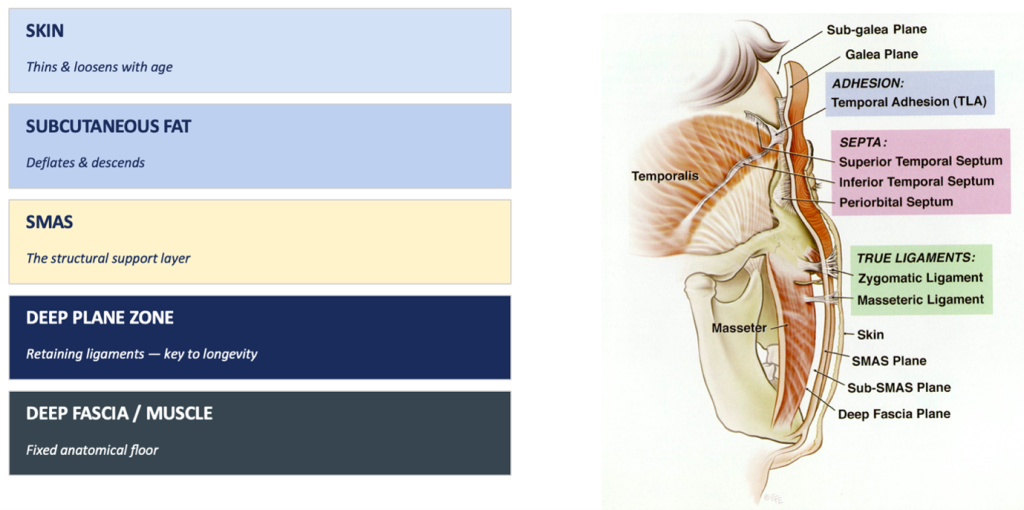
Figure 1. The layers of the face. Ref. Moss, C. J., Mendelson, B. C., & Taylor, G. I. (2000). Surgical anatomy of the ligamentous attachments in the temple and periorbital regions. Plastic and Reconstructive Surgery, 105(4), 1475–1490.
Below the SMAS lies the deep plane: a surgically defined space between the SMAS and the deeper muscles and structures of the face (the anatomy of this plane continues to be discussed in the surgical literature). It is within this plane that the retaining ligaments are encountered — most importantly the zygomatic ligaments at the level of the cheek bone, and the masseteric cutaneous ligaments along the jawline.
The distinction between SMAS-based and deep plane techniques is, at its core, about which of these layers the surgeon works within — and whether the retaining ligaments are released.
SMAS-based facelifts have been a mainstay of facelift surgery for several decades, and represent a development on the purely skin-based techniques that preceded them. Rather than relying on the skin itself to carry all the tension of a lift — which tends to produce a stretched, operated-on appearance and settles quickly — SMAS techniques address the deeper fibromuscular layer and use it to provide structural support.
There are several variations of SMAS technique. In SMAS plication, the SMAS is folded on itself and sutured without being elevated from its bed. In SMAS-ectomy, a strip of SMAS is removed. In SMAS-ectomy with flap elevation, the SMAS is elevated as a flap before being repositioned and secured. This latter version may involve dissection in the deeper tissue plane.
For the most part, what these techniques share is that they work above the retaining ligaments — or at most at their superficial surface. The deeper tissues of the face, below the SMAS, are not entered. The retaining ligaments themselves are not released. This affects how far and in what direction the facial tissues can be moved: tissues above intact retaining ligaments can only be shifted a modest distance before the ligaments act as tethering points, restricting movement.
SMAS techniques, performed by experienced hands, can produce real and durable improvement. They remain appropriate for many patients, including some older patients with a less well-formed SMAS layer, and are a more accessible procedure in terms of surgical complexity and recovery. They also have anatomical limits.
The deep plane facelift, described in its modern form by Sam Hamra in 1992, operates below the SMAS and directly releases the retaining ligaments — in particular the zygomatic and masseteric ligaments. This is the key distinction.
By releasing these ligaments, the surgeon gains access to the deep facial soft tissues as a composite unit: skin, subcutaneous fat, and SMAS move together as a single layer rather than in isolation. This composite movement mirrors the way the soft tissue envelope descends as a unit with ageing, and it allows repositioning of the facial tissues in a more vertical, anatomically-directed way.
The practical consequences of this are worth understanding.
First, the midface — the cheek and nasolabial fold region — can be repositioned more directly, especially in the setting of a “high-SMAS” approach which Marten has popularised. The zygomatic ligaments are the primary tethering point that holds the cheek in its descended position with ageing. Releasing them allows the cheek to be repositioned more completely than techniques that leave the ligaments intact, because the tethering point has been addressed. This can provide a fuller cheek region, which may be further addressed with fat grafting where appropriate.
Second, because the tension in a deep plane lift is carried through the deeper composite flap rather than the skin, there is less tension on the skin itself. Because the skin lies over the repositioned deeper tissues without being pulled laterally, this approach is designed to avoid the laterally-tensioned, operated-on appearance that historically became associated with facelift surgery.
Third, because the structural repositioning takes place at a deeper anatomical level rather than being mediated through the skin, the effect is designed to be carried by the deeper tissues. As with any facelift, the degree and longevity of the result vary from patient to patient.
Finally, as the SMAS is elevated in the deep plane and raised separately to the skin (a so-called “dual plane” approach), the SMAS vector can be tailored to the anatomy of the patient — which may call for a more vertical lift of the SMAS, while allowing a more horizontal tightening of the skin flap.
The extended deep plane technique — which forms the basis of my operative approach — takes this further. In addition to releasing the zygomatic and masseteric ligaments, the dissection is extended medially to address the nasolabial fold region more directly, and the release is carried more comprehensively around the ligamentous attachments at the lateral face and jawline.
This allows more complete repositioning of the mid and lower face, and provides more thorough access to the structures that define the jawline and neck — including the anatomy that can be addressed to refine the submandibular region and define the cervicomental angle.
My approach to the extended deep plane has been shaped by time spent with multiple high volume facelift surgeons whose methods I have studied in detail: Rick Warren in Vancouver, whose approach is notable for its anatomical precision in deep plane entry and cervical ligament release forms the basis for my approach. I have incorporated the deep neck mastoid crevasse approach introduced by Ben Talei in Beverly Hills, and further popularised by George Orfaniotis in London. A systematic approach to the deep neck is also a key part of my neck technique and I’ve been fortunate to have spent time with Ozan Sozer and Tim Marten to further refine my technique with this delicate part of neck rejuvenation surgery. These influences inform a synthesis that I adapt to the individual anatomy of each patient.
The choice between SMAS and deep plane technique is not simply a matter of one being universally right for everyone. Patient factors matter: the degree of facial ageing, the anatomy of the retaining ligaments, skin quality, the presence of prior surgery, and what the patient is hoping to address.
That said, for patients with more advanced descent of the midface and nasolabial fold, and those looking to address lower face and neck ageing, the deep plane approach may be well suited to those goals. Because the tension is carried through the deeper tissues rather than the skin, the skin is not pulled laterally. Whether it is the right approach for a given person depends on their individual anatomy and goals, and results vary between patients.
The deep plane approach is a more technically demanding procedure. It requires thorough knowledge of the deeper facial anatomy — including the facial nerve, which lies deep to the SMAS — and experience operating within that plane consistently and safely. This is one of the reasons that not all facelift surgeons offer it, and why, if you are considering a deep plane procedure, the training and operative experience of your surgeon is a relevant consideration.
My training as a dual fellowship-trained Specialist Plastic and Craniofacial Surgeon has centred on a detailed three-dimensional understanding of facial anatomy — across reconstructive, oncological, and aesthetic contexts. It is this foundation that informs how I approach the deep plane, and why I consider dedicated reconstructive and aesthetic training particularly relevant to this type of surgery.
It is worth noting that facelift terminology is not always used consistently. The term “deep plane” is sometimes applied loosely by surgeons performing more superficial techniques. Equally, the presence of a scar behind the ear or the length of a recovery are not reliable guides to the depth of dissection.
If you are researching facelift surgery and trying to understand what a given surgeon actually does in the operating theatre, the most useful questions are: at what anatomical plane do you elevate the soft tissues? Do you release the retaining ligaments, and if so, which ones and to what extent? The answers to those questions will tell you more than the name attached to the technique.
A face and neck lift — whether SMAS-based or deep plane — is a major surgical procedure performed under general anaesthesia and carries risks. These include bleeding, haematoma, infection, wound healing difficulties, scarring, asymmetry, changes in skin sensation, hair loss around the incisions, and the possibility of temporary or, less commonly, longer-lasting injury to the facial nerve branches. Deep plane surgery involves operating in closer proximity to the facial nerve than more superficial techniques, which requires experience and anatomical precision.
Before proceeding with any cosmetic surgical procedure, a referral from your GP or another registered medical practitioner is required, and a seven-day cooling-off period applies. The risks relevant to your individual anatomy and circumstances will be discussed with you in full during your consultation.
I consult at The Coastal Clinic on the Gold Coast and Fraser-Kirk Plastic Surgery on the Sunshine Coast. If you are considering a deep plane facelift and would like to understand what approach might be appropriate for you, I welcome an initial consultation.
Dr David Sparks — MBBS(Hons) MS(Plast) PhD FRACS(Plast) — Specialist Plastic Surgeon, MED0001863770
All surgery and invasive procedures carry risks. Before proceeding, you should seek a second opinion from an appropriately qualified health practitioner.







All surgery and invasive procedures carry risks. Before proceeding, you should seek a second opinion from an appropriately qualified health practitioner. Read our full information on the risks of surgery. Dr David Sparks — Specialist Plastic Surgeon, MED0001863770.