Fraser-Kirk Plastic Surgery
Sunshine Coast
Level 3/37 The Esplanade,
Maroochydore QLD 4558
Why the neck changes in layers, why a full neck often runs in families, and why treatment means addressing more than the skin. Watch a horse flick a fly from its flank without moving a leg and you’re seeing the panniculus carnosus at work: a thin sheet of muscle lying just beneath the skin, which […]
Watch a horse flick a fly from its flank without moving a leg and you’re seeing the panniculus carnosus at work: a thin sheet of muscle lying just beneath the skin, which many animals use to twitch it. In humans, most of that muscle sheet disappeared over the course of evolution. One of the pieces we kept is the platysma, a broad, thin muscle that runs from the collarbones, up over the front of the neck, to the jawline.
For most of our lives, we barely notice it. Then, for many people, the platysma starts to announce itself as two vertical cords at the front of the neck. Combined with loose skin and fullness beneath the chin, it creates what is commonly called a “turkey neck”.
Concerns about the neck are among the most common reasons people seek facial surgery, and the neck is one of the most frequently undertreated areas of the face. This post explains what’s actually happening beneath the skin, why it develops, and what the treatment options are.
“Turkey neck” is a colloquial description rather than a medical term. It usually refers to loose or hanging skin and soft tissue at the front of the neck, often with visible vertical bands. Clinically, I’d describe it as neck-related soft tissue excess, and that is the term I’ll use from here on, because it more accurately reflects what’s going on.
In neck-related soft tissue excess, the cervicomental angle, between the chin and the neck, becomes more obtuse, and soft tissue sits over the border of the jaw.
What’s important to understand is that this is almost never just a skin problem. It is the combined result of several layers of the neck, and each of them can contribute to a different degree.
The skin. Neck skin is thinner than facial skin and has fewer oil glands. It’s frequently exposed to the sun and frequently forgotten by sunscreen. With time it loses collagen and elasticity, becomes crepey, and no longer springs back into position.
The platysma muscle. In many people, the two halves of the platysma separate in the midline, and their free inner edges become visible as vertical bands, particularly when talking or straining. Laxity of the platysma also allows the deeper structures of the neck to sag forward.
Fat above and below the muscle. Fat beneath the chin sits in two places: above the platysma, just under the skin, and beneath it, deeper in the neck. The fat above the muscle can be reduced with liposuction. The fat beneath it, called subplatysmal fat, can’t be reached that way and is often the reason a neck stays full after treatment.
The deep neck structures. This is the part of the neck most patients have never heard of. The submandibular salivary glands, which sit just below the jawline on each side, can be large or can descend and become visible as fullness under the jaw. The anterior belly of the digastric muscle, which runs beneath the chin, can be bulky. Both can blunt the neck angle and the jawline in a way that tightening skin and muscle alone doesn’t address.
Weight change. Significant weight gain or loss changes the volume and support of the neck’s soft tissues and can bring these changes forward.
For many patients, a full neck has little to do with ageing. They’ve had it for as long as they can remember, often since early adulthood, and when I ask, they’ll tell me their mother or father, and often their brothers and sisters, have the same neck. This is a hereditary anatomical feature, and it’s one of the most common reasons younger patients come to see me about their neck.
In these patients, the fullness usually comes from several components working together rather than any one alone:
A small or set-back jaw and chin. When the lower jaw is short or the chin sits further back, the soft tissues of the neck have less skeletal structure to support them, and the neck angle is softer from the start.
Excess subplatysmal fat. Some people naturally carry more fat beneath the platysma. It isn’t reduced by diet or exercise in the way people expect, and it can’t be removed with liposuction.
Excess gland tissue. Larger or lower-sitting submandibular glands create fullness just below the jawline on each side.
Enlarged digastric muscles. Bulky anterior digastric muscles can create a fullness or two parallel ridges beneath the chin.
A lower-set hyoid bone. The hyoid is a small, horseshoe-shaped bone at the top of the neck. When it sits lower and further forward, the neck angle is naturally more obtuse.
This is why a full neck in a slim, younger patient often doesn’t change with diet, exercise or non-surgical fat reduction: the fullness sits in structures those treatments don’t reach. Identifying which components are present, and in what proportion, is the key to planning treatment.
Some aspects can be improved without surgery, in the right patient. Good sun protection and skincare help skin quality. Energy-based devices can produce modest skin tightening. Fat-reduction treatments or small-volume liposuction may help a patient whose main concern is fat above the platysma and whose skin has good elasticity. Some injectable treatments can soften platysmal bands temporarily, and I’m happy to discuss these in consultation.
None of these tighten a separated platysma, remove significant excess skin, or address subplatysmal fat, the glands, the digastric muscles or the underlying skeleton. Where those are the cause, non-surgical treatments reach their limit quickly.
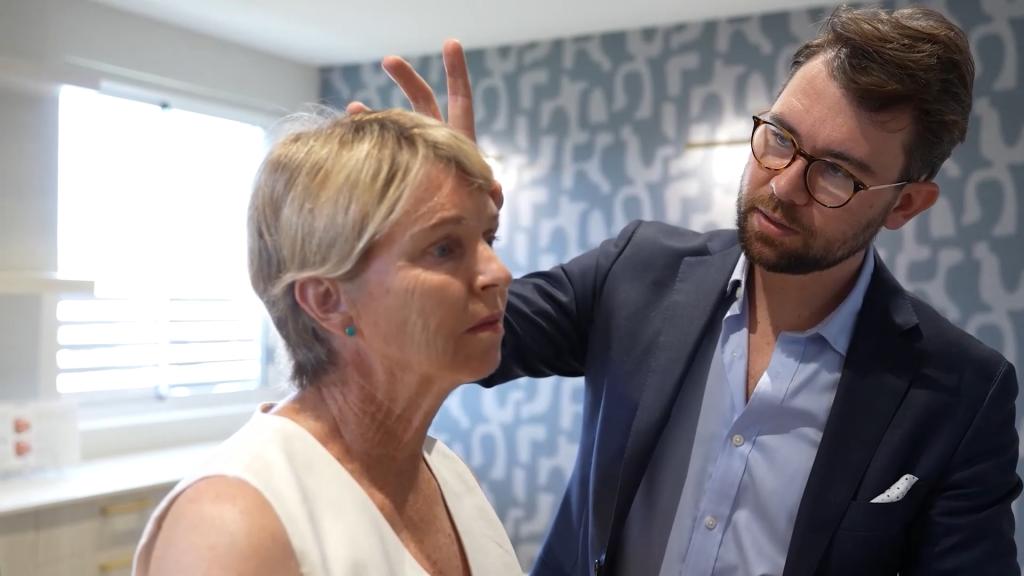
A neck lift (platysmaplasty) is the surgical treatment for neck-related soft tissue excess. Where the lower face has also changed, it’s usually performed together with a face lift, because the jawline sits exactly where the two meet. I think of the neck as needing its own dedicated anatomical strategy, rather than being a secondary benefit of a facelift.
Depending on the anatomy, my approach can include:
Midline platysma plication. Through a small incision under the chin, the separated inner edges of the platysma are brought together and sutured, like tightening a corset. This addresses the vertical bands and re-establishes a supportive sling beneath the jaw.
Lateral platysma and mastoid crevasse plication. Securing the back edge of the platysma to the firm tissue behind the ear helps set the angle of the neck and supports the tissue where the jaw meets the neck.
Selective deep neck reduction. Where they contribute, subplatysmal fat is conservatively reduced, the anterior digastric muscles can be contoured, and enlarged or descended submandibular glands can be carefully reduced. These steps are technically demanding and aren’t necessary in every patient, but where the anatomy calls for them, they address structures that tightening alone does not.
Skin redraping. Where there is skin excess, the skin is redraped and the excess removed through incisions around the ear and into the hairline behind it. Younger patients with a hereditary full neck and good skin quality may not need this.
Skeletal support. Where a small jaw or set-back chin is a major contributor, chin or jaw augmentation may be discussed as part of the plan.
Skin quality. Nanofat, a filtered preparation of the patient’s own fat, can be placed into the skin of the front of the neck with the aim of supporting skin quality over the months after surgery. The evidence for this is still developing, and results differ between individuals.
The aim is to address each layer that contributes, rather than the skin alone. I explain how this fits into facial surgery more broadly in Why I Don’t Just Perform a Facelift.
Neck surgery is performed under general anaesthesia. Swelling, bruising and a feeling of tightness in the neck are expected in the first two weeks, and a support garment is worn. Most patients return to desk-based work in two to three weeks. Swelling in the deeper neck continues to settle for several months, and the final contour is usually assessed from around three to six months. My guide to recovery after face and neck lift surgery covers this week by week.
Is a full neck hereditary? Often, yes. A small jaw, excess subplatysmal fat, larger submandibular glands, bulky digastric muscles and a lower-set hyoid bone can all be inherited, and they frequently run in families.
Why hasn’t diet or exercise changed my neck? Much of the fullness in a hereditary full neck sits beneath the platysma muscle, or comes from glands, muscle and bone structure, which diet and exercise don’t change.
What’s the difference between a neck lift and liposuction? Liposuction removes fat above the platysma only. A neck lift can also tighten the platysma, address deeper structures and remove excess skin.
Why do I have neck bands? Vertical neck bands are usually the inner edges of the platysma muscle, which separate and become visible over time.
Where are the scars from a neck lift? Typically, a small incision beneath the chin and, where skin is removed, incisions around and behind the ear extending into the hairline, placed to be as inconspicuous as possible.
Neck-related soft tissue excess is layered anatomy: skin, muscle, fat above and below the muscle, the glands and muscles of the deep neck, and the skeleton beneath them all. Whether the change has developed with time or has been part of your family’s features for generations, the plan depends on which of those layers are contributing. Which of them need treatment in your case is something we’d work out together in consultation.
A neck lift is a surgical procedure performed under general anaesthesia, and it carries real risks, which are discussed with you in full at consultation and again before surgery. Complications can include bleeding, haematoma — a collection of blood beneath the skin — infection, wound healing difficulties, scarring, asymmetry, contour irregularity, changes in skin sensation, and injury to the nerve branches that control movement of the lower lip, which is uncommon and usually temporary.
Deep neck procedures, including submandibular gland reduction, carry additional specific risks, including bleeding, a collection of saliva, and a dry mouth, which will be discussed if they are relevant to you. Chin or jaw augmentation carries its own risks, which are discussed separately.
Recovery takes weeks rather than days, and further surgery is sometimes required. Outcomes vary between individuals according to anatomy, healing and other factors.
Before proceeding, a referral from your GP or another registered medical practitioner is required, and a seven-day cooling-off period applies. All of this will be discussed with you carefully in advance.
I consult at The Coastal Clinic on the Gold Coast and Fraser-Kirk Plastic Surgery on the Sunshine Coast. If you are considering neck surgery and would like to understand what’s driving the changes in your case, I welcome an initial consultation.
Dr David Sparks — MBBS(Hons) MS(Plast) PhD FRACS(Plast) — Specialist Plastic Surgeon, MED0001863770
All surgery and invasive procedures carry risks. Before proceeding, you should seek a second opinion from an appropriately qualified health practitioner.







All surgery and invasive procedures carry risks. Before proceeding, you should seek a second opinion from an appropriately qualified health practitioner. Read our full information on the risks of surgery. Dr David Sparks — Specialist Plastic Surgeon, MED0001863770.