Fraser-Kirk Plastic Surgery
Sunshine Coast
Level 3/37 The Esplanade,
Maroochydore QLD 4558
Patient profile
Age: Middle-aged | Sex: Female | Relevant history: Multiple Aquamid (permanent) filler injections to the upper lip over many years Photography: Preoperative & 6 weeks postoperative
This case describes the cosmetic surgical management of an elongated upper lip with retained permanent filler in a middle-aged woman who had received multiple injections of Aquamid — a permanent (non-dissolvable) filler — to the upper lip over many years. She sought removal of the filler together with a change in the shape and proportion of her upper lip, which had lengthened and lost definition of contour over time. The two goals were addressed in a single, coordinated operation: transmucosal removal of as much of the permanent filler as safely achievable, followed by a deep plane upper lip lift and lateral corner (wing) lift performed according to the CUPID design described by Talei. This approach allows the upper lip to be reshaped — not merely shortened — with individual control over each segment of the lip.
Detailed clinical evaluation identified the following features:
The plan addressed the two concerns in one operative episode: first, reduction of the retained permanent filler through a concealed internal approach; and second, reshaping of the upper lip using the CUPID deep plane lip lift design.
A conventional subnasal (‘bullhorn’) lip lift shortens the lip by excising a strip of skin beneath the nose and closing the skin superficially. The CUPID deep plane upper lip lift, described by Talei, instead works through a deeper plane and uses a rotational advancement of the lip towards the nose, hinged around the incision. This allows each segment of the lip to be individually controlled — shortening the philtrum while simultaneously everting and increasing the visible vermilion, restoring the contour of the Cupid’s bow, and improving tooth show, with the scar sited in the subnasal crease. This approach was selected for this patient because her goals included reshaping of the vermilion and Cupid’s bow, not shortening alone. It is a technique I use routinely for this indication.
Addressing the retained filler at the same sitting is logical: the internal (transmucosal) exposure required to reduce the filler complements the lip lift, and reshaping of the lip is best judged once the distorting filler has been reduced. The patient was clearly counselled that permanent fillers such as Aquamid cannot be completely removed, and that the objective was maximal safe reduction rather than total clearance.
Transmucosal incisions were made on the internal (mucosal) surface of the upper lip, avoiding any external scar. Through this concealed access, the retained Aquamid was identified and removed, with approximately 90% of the material cleared. Consistent with the preoperative discussion, complete removal of a permanent filler is not achievable; the aim was maximal safe reduction while preserving the neurovascular and muscular integrity of the lip.
A deep plane upper lip lift was performed according to the CUPID design (Talei). A subnasal excision of skin was marked and executed to shorten the elongated cutaneous upper lip, with the incision sited within the crease at the base of the nose. Working in the deep plane allowed rotational advancement of the lip towards the nose, everting and increasing the visible vermilion, restoring the contour of the Cupid’s bow, and improving incisal show — reshaping the lip rather than simply shortening it.
A lateral wing lift was performed to complement the central lift, elevating the lateral segments of the upper lip. This maintains a smooth, continuous vermilion contour from the midline to the corners and avoids central-only over-shortening, which can unbalance the lip.
No fat grafting or other adjunctive volumising procedures were performed. The change in lip volume and red-lip show was achieved through the deep plane lift and vermilion eversion alone, without added volume.
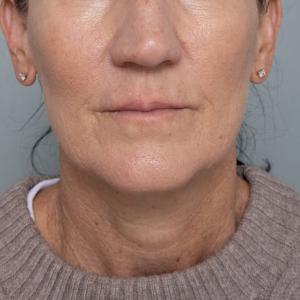
At six weeks postoperatively, change was visible in the targeted areas, with settling and scar maturation continuing well beyond this early timepoint. Features noted included:
The combination of maximal safe filler reduction and a CUPID deep plane lip lift reshaped the upper lip into a shorter, re-contoured configuration, addressing both the retained filler and the patient’s goals for lip shape in a single operation. A GP referral is recommended before a surgical consultation, and a cooling-off period applies before proceeding with cosmetic surgery. All surgery carries risk; full information on the risks of surgery and recovery is available here, and a second opinion from an appropriately qualified health practitioner is encouraged.
Standardised clinical photography: preoperative and 6 weeks postoperative.
PREOPERATIVE
6 WEEKS POSTOPERATIVE
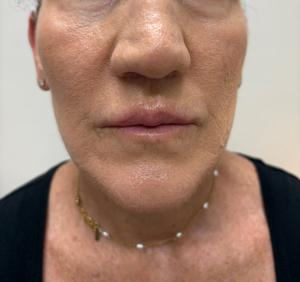 Pre-operative & 6-weeks post-operative. Additional views available on request.
This result is specific to this patient. It is shown with the patient’s consent and is not a prediction of any other person’s result. Outcomes vary between individuals according to anatomy, healing and other factors. These images are taken at six weeks, when some swelling is still present and the final result has not yet settled.
| Component | Detail |
|---|---|
| Indication | Cosmetic — elongated upper lip, retained permanent filler, loss of lip contour |
| Filler history | Aquamid (permanent) — multiple injections over years |
| Filler removal | Transmucosal (internal) approach; approximately 90% removed |
| Lip lift technique | CUPID deep plane upper lip lift (Talei) |
| Skin excision | Subnasal excision, scar sited in the nasal-base crease |
| Corner lift | Lateral wing lift |
| Fat grafting | Not performed |
| Stages | Single-stage, combined procedure |
| Photography | Preoperative & 6 weeks postoperative |
The lip lift in this case was designed and performed according to the CUPID deep plane upper lip lift and corner lift described by Talei and Pearlman. The deep plane CUPID design permits individualised control of lip shape through a rotational advancement in the deep plane, reshaping the vermilion and Cupid’s bow rather than shortening the lip alone. In the originating series of over 2,440 consecutive lip lifts, the authors describe changes in lip balance, tooth show, and vermilion exposure achieved with this design. The patient was counselled that permanent fillers such as Aquamid cannot be fully removed, and that maximal safe reduction was the realistic goal. Reference: Talei B, Pearlman SJ. CUPID Lip Lift: Advanced Lip Design Using the Deep Plane Upper Lip Lift and Simplified Corner Lift. Aesthetic Surgery Journal. 2022;42(12):1357–1373. doi:10.1093/asj/sjac126.
AHPRA Compliance Notice: This case study is intended for general information purposes only. Individual outcomes vary, as the result experienced by one person does not necessarily reflect the result another person may experience. All surgical procedures carry risks and require a recovery period. Results shown are specific to this patient and cannot be guaranteed for others. Surgery should only be considered after thorough consultation with an appropriately qualified Specialist Plastic Surgeon, and a second opinion is encouraged. Full information on the risks of surgery and recovery is available on our risks of surgery page. This content does not constitute medical advice.
Dr David Sparks — Specialist Plastic Surgeon | FRACS (Plast.) | MED0001863770 | The Coastal Clinic, Southport QLD | Fraser-Kirk Plastic Surgery, Sunshine Coast QLD







All surgery and invasive procedures carry risks. Before proceeding, you should seek a second opinion from an appropriately qualified health practitioner. Read our full information on the risks of surgery. Dr David Sparks — Specialist Plastic Surgeon, MED0001863770.